
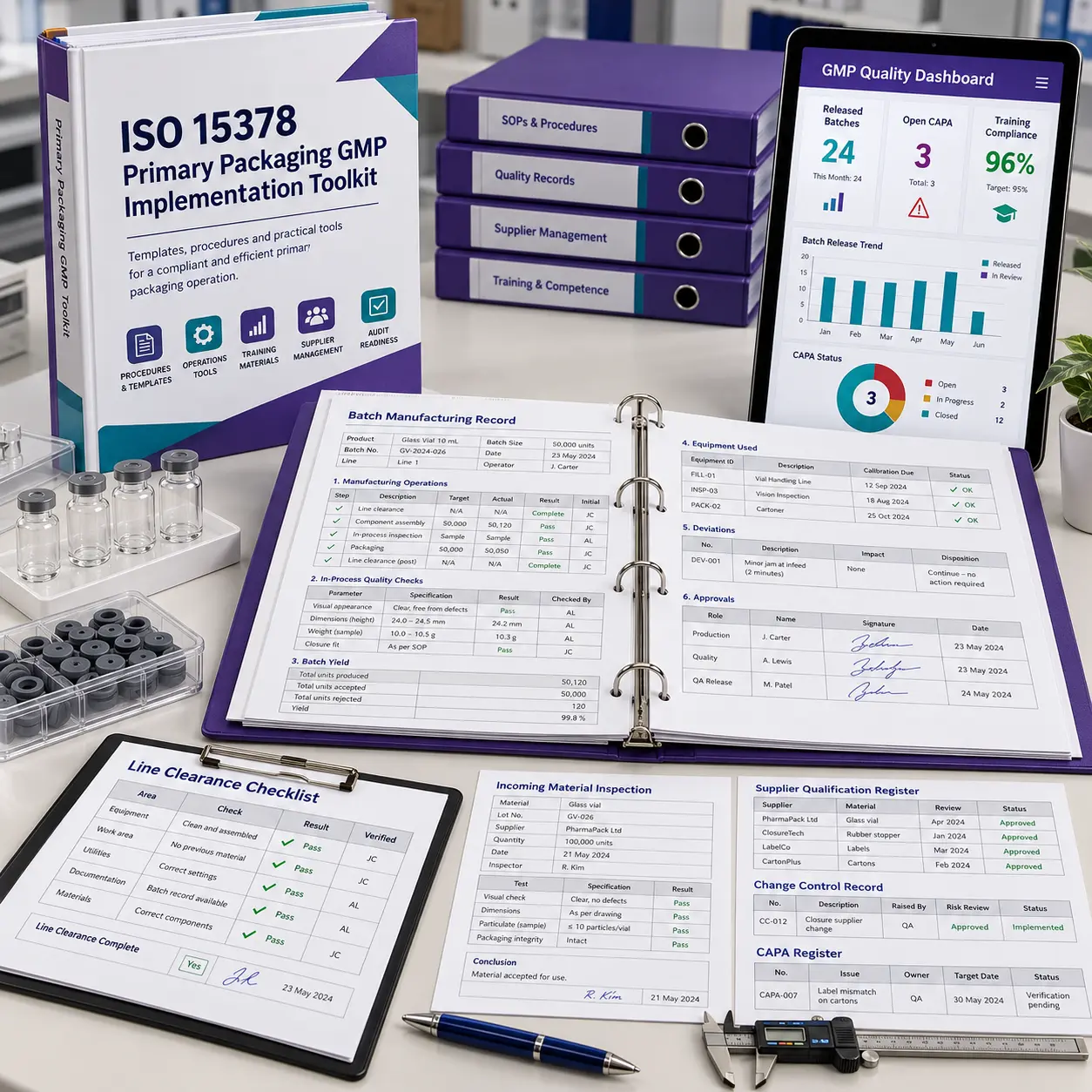
ISO 15378:2017 Primary Packaging GMP Implementation Toolkit
The ISO 15378 Primary Packaging GMP Implementation Toolkit provides editable policies, procedures, batch records, registers, workbooks and training presentations to help organizations establish and maintain quality and GMP controls for primary packaging materials used with medicinal products.
Organized into 18 implementation areas, the toolkit supports QMS scope and leadership, supplier qualification, hygiene, contamination control, production, traceability, qualification and validation, testing, batch release, CAPA and internal review. Its document set includes climate relevance assessments supporting the 2024 amendment context. Adapt the files to your materials, manufacturing processes, customer specifications and applicable requirements.
ISO 15378 Toolkit Value & Pricing
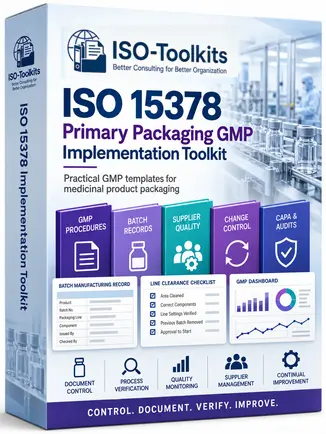
Implementing ISO 15378 involves coordinating quality management with the GMP controls relevant to primary packaging. Organizations need reliable supplier and specification controls, hygienic operations, documented batch production, traceability, appropriate validation and consistent testing, release and improvement records.
The ISO 15378 Primary Packaging GMP Implementation Toolkit provides a comprehensive collection of editable templates and structured implementation documents in Word, Excel and PowerPoint formats. It helps your organization prepare a coordinated QMS and GMP document set, standardize records and organize internal audits, management review and certification readiness for your actual manufacturing scope.

ISO 15378 Toolkit Document Index
Below is the structured list of documents included in the package. Expand each part to review the files before downloading the index file.
 Part 1. ISO 15378 Implementation Governance and Project Initiation
 ISO 15378 Implementation Project Charter.docx ISO 15378 Implementation Governance Framework.docx Quality and GMP Implementation Plan.docx Implementation Team Terms of Reference.docx Implementation Roles Responsibilities and Authorities.docx
 ISO 15378 Project RACI Matrix.xlsx ISO 15378 Stakeholder Register.xlsx ISO 15378 Project Schedule and Milestone Tracker.xlsx ISO 15378 Requirements Traceability Matrix.xlsx ISO 15378 Baseline Readiness Assessment.xlsx
 ISO 15378 Project Kickoff Presentation.pptx ISO 15378 Executive Awareness Presentation.pptx
Part 2. Organizational Context, QMS Scope and Leadership
Organization Context Assessment.docx QMS Scope Definition.docx Interested Parties and Requirements Assessment.docx Climate Change Relevance Assessment.docx Quality Policy Template.docx Quality Objectives and Planning Framework.docx Leadership Commitment and GMP Responsibility Record.docx Internal and External Issues Register.xlsx Interested Parties Requirements Register.xlsx Climate Related Requirements Register.xlsx QMS Process Interaction Matrix.xlsx Quality Objectives and KPI Register.xlsx Organization Context and QMS Scoping Workshop.pptx
Part 3. Statutory, Regulatory, Customer and GMP Requirements Management
Statutory and Regulatory Requirements Management Procedure.docx Customer and Product Requirements Review Procedure.docx Applicable Standards and Pharmacopoeial Requirements Assessment.docx Quality Agreement Template.docx Technical Agreement Template.docx Customer Change Notification Requirements Form.docx Statutory and Regulatory Requirements Register.xlsx Customer Specific Requirements Register.xlsx Applicable Standards and Pharmacopoeia Register.xlsx Quality and Technical Agreement Tracker.xlsx Customer Notification Obligations Matrix.xlsx Regulatory and Customer Requirements Workshop.pptx
Part 4. Quality Risk Management and GMP Control Strategy
Quality Risk Management Procedure.docx Quality Risk Assessment Form.docx Contamination Risk Assessment Form.docx Mix Up and Cross Contamination Risk Assessment.docx GMP Control Strategy.docx Risk Acceptance and Escalation Criteria.docx Quality Risk Register.xlsx FMEA Risk Assessment Workbook.xlsx Contamination Risk Register.xlsx GMP Risk Control Action Tracker.xlsx Periodic Risk Review Schedule.xlsx Quality Risk Management Workshop.pptx
Part 5. Documented Information, Records and Data Integrity
Documented Information Control Procedure.docx Records Control and Retention Procedure.docx Good Documentation Practices Procedure.docx Electronic Records and Data Integrity Procedure.docx Controlled Forms and Templates Management Procedure.docx Archiving and Record Retrieval Procedure.docx Master Document Register.xlsx Controlled Form Register.xlsx Record Retention Schedule.xlsx Authorized Signature and Approval Matrix.xlsx Electronic System Access and Privilege Register.xlsx Good Documentation Practices Training.pptx Data Integrity Awareness Training.pptx
Part 6. Personnel, Competence, Training and Hygiene
Competence Training and Awareness Procedure.docx Personnel Hygiene and Gowning Procedure.docx Personnel Health and Fitness Declaration Form.docx Visitor and Contractor GMP Control Procedure.docx Job Description Template.docx Training Effectiveness Assessment Form.docx Competency Matrix.xlsx GMP Training Matrix.xlsx Personnel Training Record and Status Tracker.xlsx Gowning and Hygiene Qualification Register.xlsx Authorized Personnel Register.xlsx Personnel GMP and Hygiene Training.pptx
Part 7. Premises, Utilities and Controlled Manufacturing Environment
Premises and Facility Control Procedure.docx Factory Hygiene and Sanitation Procedure.docx Pest Control Procedure.docx Controlled Environment Management Procedure.docx HVAC and Environmental Condition Control Procedure.docx Critical Utilities Monitoring Procedure.docx Room and Area Classification Register.xlsx Environmental Monitoring Plan and Register.xlsx Temperature Humidity and Pressure Trend Log.xlsx Sanitation and Housekeeping Schedule.xlsx Pest Control Monitoring Log.xlsx Critical Utilities Qualification and Monitoring Register.xlsx Facility and Environmental GMP Controls Presentation.pptx
Part 8. Equipment, Tooling, Maintenance and Calibration Control
Equipment Lifecycle Control Procedure.docx Equipment Operation and Cleaning Procedure.docx Preventive Maintenance Procedure.docx Calibration and Metrology Control Procedure.docx Mould Tool and Die Control Procedure.docx Equipment Breakdown and Repair Record.docx Equipment Master Register.xlsx Preventive Maintenance Schedule and Log.xlsx Calibration Master Schedule and Status Register.xlsx Mould Tool and Die Register.xlsx Equipment Cleaning and Use Log.xlsx Equipment and Metrology Control Training.pptx
Part 9. Supplier, Outsourced Process and Incoming Material Control
Supplier Qualification and Monitoring Procedure.docx Supplier Risk Assessment Form.docx Purchasing and External Provider Control Procedure.docx Incoming Material Receipt and Inspection Procedure.docx Supplier Audit Checklist.docx Supplier Change Notification and Approval Form.docx Outsourced Process Control Agreement Template.docx Approved Supplier List.xlsx Supplier Risk Rating Workbook.xlsx Supplier Audit and Assessment Tracker.xlsx Incoming Material Inspection and Acceptance Log.xlsx Supplier Performance Scorecard.xlsx Supplier Change Notification Register.xlsx Supplier Quality Management Presentation.pptx
Part 10. Product Requirements, Specifications and Design and Development
Contract and Order Review Procedure.docx Product Specification Management Procedure.docx Design and Development Control Procedure.docx Design and Development Plan Template.docx Design Input Requirements Form.docx Design Output Record.docx Design Review Record.docx Design Verification and Validation Record.docx Design Change Control Form.docx Customer Sample and Approval Record.docx Product Specification Master Register.xlsx Design Requirements Traceability Matrix.xlsx Design Project and Review Tracker.xlsx Design Verification and Validation Tracker.xlsx Design Change Register.xlsx Product and Design Review Presentation.pptx
Part 11. Production Planning, Manufacturing and Batch Control
Production Planning and Control Procedure.docx Master Manufacturing Instruction Template.docx Batch Manufacturing Record Template.docx Line Clearance Procedure.docx In Process Control Procedure.docx Critical Process Parameter Control Procedure.docx Printing Artwork and Label Control Procedure.docx Material and Label Reconciliation Procedure.docx Production Batch Schedule.xlsx Batch Genealogy and Material Traceability Log.xlsx Line Clearance Checklist.xlsx In Process Control Log.xlsx Critical Process Parameter Trend Log.xlsx Yield and Material Reconciliation Workbook.xlsx Printing and Label Reconciliation Log.xlsx Production GMP and Batch Control Training.pptx
Part 12. Cleanliness, Contamination and Microbiological Control
Contamination Control Procedure.docx Cleaning and Sanitation Control Procedure.docx Microbiological Contamination Control Procedure.docx Particulate and Foreign Matter Control Procedure.docx Material Personnel and Waste Flow Control Procedure.docx Clean Area Behaviour and Practices Procedure.docx Cleaning and Sanitation Schedule.xlsx Environmental Microbiological Monitoring Log.xlsx Particulate and Foreign Matter Monitoring Log.xlsx Bioburden Monitoring Trend.xlsx Contamination Incident Register.xlsx GMP Hygiene and Cleanliness Audit Checklist.xlsx Contamination Control and Clean Manufacturing Training.pptx
Part 13. Identification, Traceability, Status Control, Handling and Preservation
Product Identification and Traceability Procedure.docx Batch and Lot Coding Procedure.docx Inspection Status Quarantine and Release Procedure.docx Segregation and Status Labeling Procedure.docx Handling Preservation Packaging and Storage Procedure.docx Customer Property Control Procedure.docx Product Shelf Life and Retest Control Procedure.docx Lot and Batch Traceability Register.xlsx Inventory Status and Quarantine Register.xlsx Material and Product Status Label Register.xlsx Storage Condition Monitoring Log.xlsx Shelf Life and Retest Status Register.xlsx Customer Property Register.xlsx Traceability and Status Control Exercise.pptx
Part 14. Qualification, Validation and Validated State Control
Validation Master Plan.docx Qualification Protocol and Report Template.docx Process Validation Protocol and Report Template.docx Cleaning Validation Protocol and Report Template.docx Computerized System Validation Procedure.docx Analytical Method Validation or Verification Protocol.docx Special Process Validation Protocol and Report.docx Revalidation and Periodic Review Procedure.docx Validation Master Schedule.xlsx Equipment and Utility Qualification Register.xlsx Process Validation Status Register.xlsx Cleaning Validation Status Register.xlsx Computerized System Validation Register.xlsx Revalidation Trigger and Status Register.xlsx Validation and Qualification Governance Presentation.pptx
Part 15. Sampling, Laboratory Control, Inspection, Testing and Batch Release
Sampling and Sample Management Procedure.docx Inspection and Testing Procedure.docx Laboratory Control Procedure.docx Specification and Test Method Control Procedure.docx Out of Specification and Out of Trend Investigation Procedure.docx Certificate of Analysis Template.docx Certificate of Conformance Template.docx Batch Release and Final Approval Procedure.docx Retention and Reference Sample Procedure.docx Sampling Plan and Acceptance Criteria.xlsx Inspection and Test Result Log.xlsx OOS and OOT Investigation Register.xlsx Batch Release Register.xlsx Certificate Issuance Register.xlsx Retention and Reference Sample Register.xlsx Laboratory and Batch Release GMP Training.pptx
Part 16. Deviations, Nonconforming Outputs, CAPA and Change Control
Deviation Management Procedure.docx Nonconforming Output Control Procedure.docx CAPA Procedure.docx Root Cause Analysis Form.docx Change Control Procedure.docx Temporary Change and Planned Deviation Form.docx Rework and Reprocessing Control Procedure.docx Concession and Use As Is Approval Form.docx Deviation Register.xlsx Nonconformance Register.xlsx CAPA Tracker.xlsx Change Control Register.xlsx CAPA Effectiveness Check Tracker.xlsx Rework and Reprocessing Register.xlsx Deviation CAPA and Change Control Training.pptx
Part 17. Complaints, Distribution Traceability, Recall and Customer Feedback
Customer Complaint Handling Procedure.docx Product Quality Complaint Investigation Form.docx Product Recall and Withdrawal Procedure.docx Mock Recall Procedure.docx Distribution and Dispatch Control Procedure.docx Customer Notification and Field Action Form.docx Complaint Register.xlsx Complaint Investigation and Trending Workbook.xlsx Distribution and Dispatch Traceability Register.xlsx Recall and Withdrawal Traceability Log.xlsx Mock Recall Test and Effectiveness Log.xlsx Customer Feedback and Satisfaction Tracker.xlsx Recall and Complaint Response Simulation.pptx
Part 18. Internal Audit, Management Review, Improvement and Certification Closeout
Internal Audit and GMP Self Inspection Procedure.docx ISO 15378 Internal Audit Checklist.docx GMP Self Inspection Checklist.docx Management Review Procedure.docx Management Review Agenda and Minutes Template.docx Quality Performance Evaluation Procedure.docx Continual Improvement Procedure.docx Certification Readiness Review Checklist.docx ISO 15378 Implementation Closeout Report.docx Implementation Handover and System Ownership Record.docx Lessons Learned Record.docx Internal Audit Programme.xlsx Internal Audit Findings and Action Register.xlsx Quality and GMP KPI Dashboard.xlsx Management Review Action Tracker.xlsx Continual Improvement Action Register.xlsx Certification Readiness Gap Closure Tracker.xlsx Implementation Closeout Checklist.xlsx ISO 15378 Internal Auditor Training.pptx ISO 15378 Management Review Presentation.pptx ISO 15378 Certification Readiness Presentation.pptx ISO 15378 Project Closeout and Handover.pptxReview the complete file index, preview free sample templates, or check the purchase and payment guide.
ISO 15378 Toolkit Package & Download Information
| Date File Updated | 06/11/2020 |
| File Format | doc, docx, xls, xlsx, ppt, pptx |
| No. of files | 253 Files, 18 Folders |
| File download size | 46.73 MB (.rar) |
| Language |
 English |
| Purchase code | ISO15378-Toolkits |
Ready to Strengthen Your Primary Packaging Quality & GMP System?
Start with the ISO 15378 Primary Packaging GMP Implementation Toolkit or review the free sample before purchasing.
The batch manufacturing record was a useful framework for our packaging line. We replaced the generic steps with our approved manufacturing instructions and inspection points.
The change notification matrix helped us clarify which customer approvals were needed for material and process changes. It was easier to review than our old email based list.
We adapted the supplier audit checklist and qualification register to our packaging components. They gave purchasing and quality a more consistent way to track open findings.
The line clearance and label reconciliation records were straightforward to customize. They helped us keep the checks and sign offs together for each production batch.
The personnel hygiene and training documents helped us review our existing records. We adjusted the instructions to our facility requirements and approval responsibilities.
The validation master schedule helped us organize equipment and cleaning review activities. We could see the outstanding documents and assigned owners much more clearly.
I found the contamination risk register useful for our cross functional workshop. It gave us a consistent place to record risks, current controls and further actions.
The incoming inspection log and certificate register helped us connect accepted materials to their supporting records. We added the specifications used by our customers.
The mock recall log made it easier to record the exercise scope, traceability gaps and follow up actions. We used our actual distribution records to complete the test.
The CAPA tracker separates action completion and effectiveness review clearly. That was helpful when we updated our quality review meeting records.
The GMP self inspection checklist was a practical starting point for our internal review. We tailored the questions to the areas and processes in our packaging operation.
The management review slides and KPI register helped us prepare a more focused agenda. We adapted the indicators to our complaints, batch records and supplier performance.