
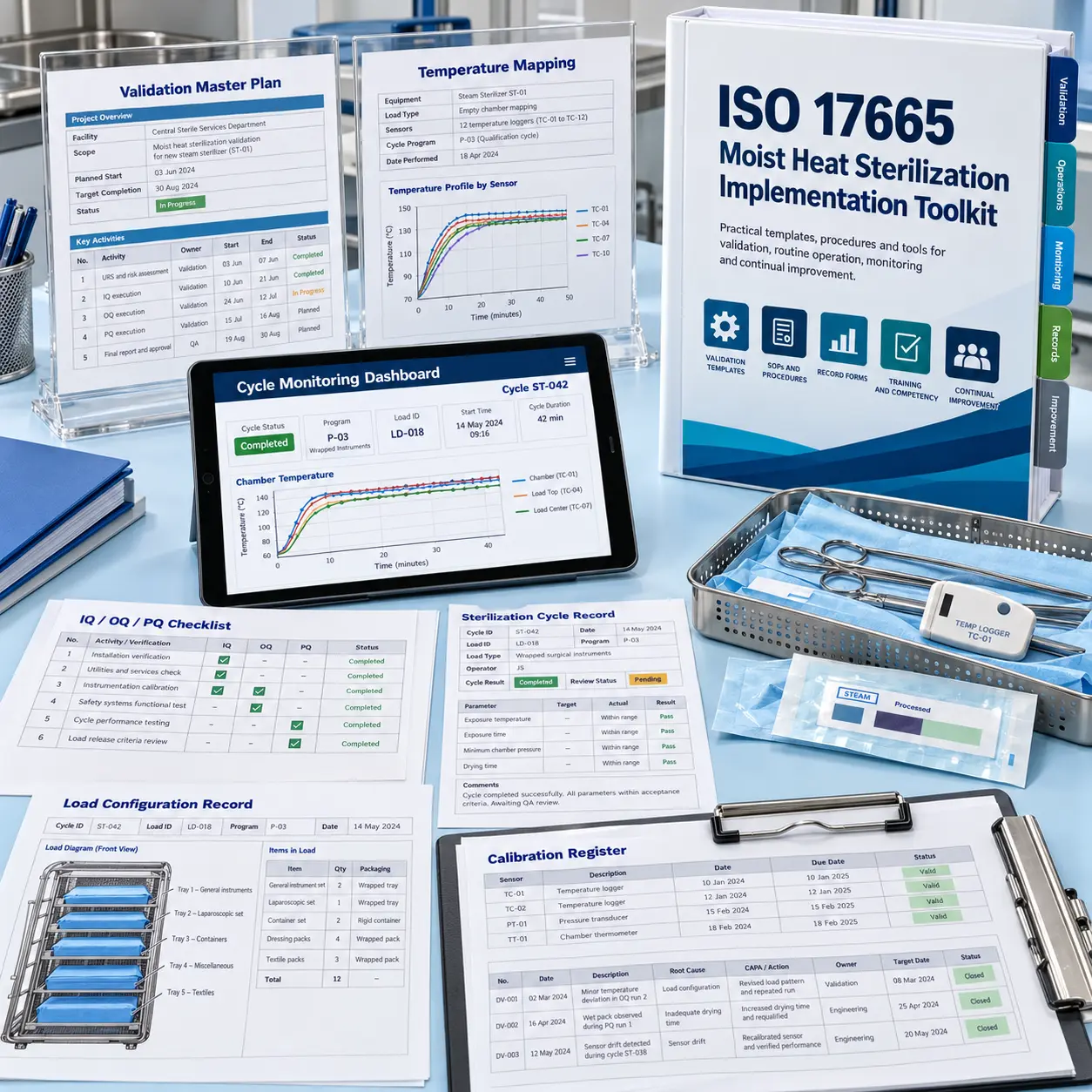
ISO 17665:2024 Moist Heat Sterilization Implementation Toolkit
The ISO 17665 Moist Heat Sterilization Implementation Toolkit provides editable procedures, qualification protocols, records, workbooks and training presentations to help teams organize the development, validation and routine control of moist heat sterilization processes for medical devices.
Aligned with the ISO 17665:2024 process framework, the 20 implementation areas cover product and equipment characterization, utilities, measurement, load configurations, cycle development, IQ/OQ/PQ, microbiological evaluation, routine monitoring, release and requalification. Adapt each document to your actual equipment, products and approved process criteria, then complete the required studies and technical reviews.
ISO 17665 Toolkit Value & Pricing
Moist heat sterilization implementation requires coordinated work across quality, engineering, microbiology and operations. Teams need to define products and loads, characterize equipment and utilities, develop the process, qualify performance and maintain dependable monitoring and release records.
The ISO 17665 Moist Heat Sterilization Implementation Toolkit provides a comprehensive collection of editable templates and structured implementation documents in Word, Excel and PowerPoint formats. It helps your organization prepare qualification protocols, organize validation evidence, standardize routine records and manage review, change and requalification activities within the ISO 17665:2024 framework.

ISO 17665 Toolkit Document Index
Below is the structured list of documents included in the package. Expand each part to review the files before downloading the index file.
 Part 1. ISO 17665 Implementation Governance and Project Initiation
 ISO 17665 Implementation Project Charter.docx Moist Heat Sterilization Governance Framework.docx Sterilization Program Roles Responsibilities and Authorities.docx Sterilization Validation Master Strategy.docx Sterilization Project Communication and Escalation Plan.docx
 ISO 17665 Project RACI Matrix.xlsx ISO 17665 Stakeholder Register.xlsx ISO 17665 Project Schedule and Milestone Tracker.xlsx ISO 17665 Requirements Traceability Matrix.xlsx Sterilization Document Register.xlsx
 ISO 17665 Project Kickoff Presentation.pptx ISO 17665 Executive Awareness Presentation.pptx
Part 2. Quality Management, Regulatory Requirements and Risk Management
Sterilization QMS Integration Procedure.docx Applicable Regulatory and Standards Requirements Procedure.docx Moist Heat Sterilization Risk Management Plan.docx Sterilization Process Risk Assessment Form.docx Sterility Assurance Strategy.docx Sterilization Acceptance and Escalation Criteria.docx Applicable Regulatory and Standards Register.xlsx Sterilization Risk Register.xlsx Sterilization FMEA Workbook.xlsx Sterility Assurance Requirements Matrix.xlsx ISO 17665 Compliance Gap Assessment.xlsx Sterilization QMS and Risk Management Workshop.pptx
Part 3. Personnel Competence, Documentation and Record Control
Sterilization Personnel Competence and Training Procedure.docx Sterilization Authorization and Qualification Procedure.docx Sterilization Document and Record Control Procedure.docx Sterilization Good Documentation Practices Procedure.docx Sterilization Data Integrity and Record Retention Procedure.docx Sterilization Training Effectiveness Assessment Form.docx Sterilization Competency Matrix.xlsx Sterilization Training Matrix.xlsx Authorized Sterilization Personnel Register.xlsx Sterilization Record Retention Schedule.xlsx Sterilization Training and Authorization Tracker.xlsx Moist Heat Sterilization Competency Training.pptx
Part 4. External Provider and Outsourced Sterilization Control
External Sterilization Service Qualification Procedure.docx Sterilization Service Provider Audit Checklist.docx Sterilization Quality Agreement Template.docx External Sterilization Technical Agreement Template.docx Sterilization Service Change Notification Form.docx Outsourced Sterilization Batch Release Interface Procedure.docx Approved Sterilization Service Provider List.xlsx Sterilization Service Provider Risk Assessment.xlsx Sterilization Service Provider Performance Scorecard.xlsx External Sterilization Change Notification Register.xlsx Outsourced Sterilization Batch Traceability Register.xlsx External Sterilization Service Governance Presentation.pptx
Part 5. Sterilizing Agent Characterization
Sterilizing Agent Characterization Protocol.docx Sterilizing Agent Characterization Report.docx Moist Heat Microbicidal Effectiveness Assessment.docx Sterilizing Agent Material Effects Assessment.docx Sterilizing Agent Environmental Consideration Assessment.docx Moist Heat Process Type Selection Record.docx Sterilizing Agent Characteristic Matrix.xlsx Microbicidal Effectiveness Data Register.xlsx Material Compatibility Assessment Matrix.xlsx Sterilizing Agent Environmental Aspect Register.xlsx Moist Heat Process Type Selection Matrix.xlsx Sterilizing Agent Characterization Review.pptx
Part 6. Product Definition, Packaging and Product Family Assignment
Sterilization Product Definition Template.docx Product Family and Processing Category Assignment Procedure.docx Product Material Compatibility Assessment.docx Sterile Barrier and Packaging Compatibility Assessment.docx Product Bioburden and Cleanliness Requirements Definition.docx Worst Case Product Selection Justification.docx Sterilization Product Master Register.xlsx Product Family and Processing Category Register.xlsx Product Material Compatibility Matrix.xlsx Packaging and Sterile Barrier Compatibility Matrix.xlsx Product Bioburden Profile Register.xlsx Worst Case Product Challenge Matrix.xlsx Product Definition and Family Assignment Workshop.pptx
Part 7. Process and Equipment Characterization
Moist Heat Process Characterization Protocol.docx Moist Heat Process Characterization Report.docx Sterilizer User Requirements Specification.docx Sterilizer Functional and Design Specification.docx Saturated Steam Process Characterization Record.docx Contained Product Process Characterization Record.docx Sterilizer Alarm Interlock and Control Function Specification.docx Sterilizer and Accessory Equipment Register.xlsx Sterilization Cycle Parameter Matrix.xlsx Sterilizer Alarm and Interlock Matrix.xlsx Chamber Load Carrier and Accessory Register.xlsx Sterilizer Sensor and Control Point Register.xlsx Process and Equipment Characterization Review.pptx
Part 8. Utilities, Steam, Water and Environmental Control
Sterilization Utilities Qualification Strategy.docx Steam Quality Control Procedure.docx Sterilizer Feed Water Quality Control Procedure.docx Sterilizer Cooling Water Control Procedure.docx Sterilization Utility Monitoring Procedure.docx Sterilization Utility Failure Response Procedure.docx Critical Sterilization Utility Register.xlsx Steam Quality Test Record.xlsx Non Condensable Gas Dryness and Superheat Log.xlsx Sterilizer Water Quality Monitoring Log.xlsx Critical Utility Trend and Status Tracker.xlsx Sterilization Utility Qualification and Control Presentation.pptx
Part 9. Measurement, Calibration, Instrumentation and Data Systems
Sterilization Measuring Equipment Control Procedure.docx Sterilization Calibration Procedure.docx Thermometric Measurement System Control Procedure.docx Pressure Measurement System Control Procedure.docx Sterilization Data Acquisition and Computerized System Control Procedure.docx Measurement Uncertainty Assessment Method.docx Sterilization Instrument Master Register.xlsx Calibration Master Schedule and Status Register.xlsx Thermocouple and Data Logger Register.xlsx Pressure Instrument Register.xlsx Measurement Uncertainty Workbook.xlsx Sterilization Software and Data System Register.xlsx Sterilization Measurement and Calibration Training.pptx
Part 10. Load Configuration and Process Challenge Definition
Sterilization Load Configuration Definition.docx Worst Case Load Selection Justification.docx Process Challenge Device Selection and Placement Procedure.docx Load Equivalence and Load Family Assessment.docx Sterilizer Loading and Unloading Work Instruction.docx Load Configuration Change Assessment Form.docx Approved Load Configuration Register.xlsx Load Family and Equivalence Matrix.xlsx Worst Case Load Challenge Matrix.xlsx Process Challenge Device Placement Register.xlsx Load Density and Capacity Assessment Workbook.xlsx Load Configuration and Process Challenge Workshop.pptx
Part 11. Process Definition and Sterilization Cycle Development
Sterilization Process Definition Template.docx Sterilization Cycle Development Plan.docx Sterilization Cycle Development Protocol.docx Sterilization Cycle Development Report.docx Sterilization Process Parameter Acceptance Criteria.docx Sterilization Lethality Calculation Method.docx Microbiological and Physical Process Evaluation Strategy.docx Cycle Development Run Log.xlsx Sterilization Process Parameter and Tolerance Matrix.xlsx F0 Lethality Calculation Workbook.xlsx Temperature Pressure Saturation Assessment.xlsx Cycle Development Comparison Workbook.xlsx Sterilization Cycle Development Review.pptx
Part 12. Installation Qualification (IQ)
Sterilizer IQ Plan.docx Sterilizer IQ Protocol.docx Sterilizer IQ Report.docx Sterilizer Installation Documentation Verification Form.docx Sterilizer Utility Connection Verification Form.docx Sterilizer Safety Alarm and Interlock IQ Checklist.docx Sterilizer IQ Master Checklist.xlsx Installed Component and Serial Number Register.xlsx IQ Utility Verification Workbook.xlsx IQ Drawing Manual and Certificate Register.xlsx IQ Deviation and Punch List Tracker.xlsx Installation Qualification Review.pptx
Part 13. Operational Qualification (OQ)
Sterilizer OQ Plan.docx Sterilizer OQ Protocol.docx Sterilizer OQ Report.docx Empty Chamber Heat Distribution Test Procedure.docx Air Removal and Steam Penetration Test Procedure.docx Chamber Leak Test Procedure.docx Sterilizer OQ Test Matrix.xlsx Empty Chamber Temperature Distribution Workbook.xlsx OQ Thermocouple Location Register.xlsx Air Removal and Steam Penetration Test Log.xlsx Chamber Leak Test Log.xlsx OQ Deviation Tracker.xlsx Operational Qualification Review.pptx
Part 14. Performance Qualification (PQ)
Sterilizer PQ Plan.docx Sterilizer PQ Protocol.docx Sterilizer PQ Report.docx Loaded Chamber Heat Penetration Test Procedure.docx Minimum and Maximum Load PQ Strategy.docx Worst Case Load PQ Justification.docx Microbiological PQ Execution Record.docx Physical PQ Execution Record.docx PQ Run and Replicate Matrix.xlsx Loaded Chamber Heat Penetration Workbook.xlsx PQ Sensor and Challenge Location Register.xlsx PQ F0 and Lethality Calculation Workbook.xlsx PQ Biological Indicator Result Log.xlsx PQ Deviation Tracker.xlsx Performance Qualification Review.pptx
Part 15. Microbiological Methods and Sterility Assurance Evaluation
Bioburden Monitoring and Control Procedure.docx Biological Indicator Control Procedure.docx Biological Indicator Selection and Challenge Rationale.docx Sterilization Process Microbiological Evaluation Method.docx Overkill Method Assessment Record.docx Bioburden Based Method Assessment Record.docx Sterility Assurance Level Evaluation Record.docx Biological Indicator Incubation and Result Interpretation Procedure.docx Bioburden Test Result and Trend Register.xlsx Biological Indicator Lot and Qualification Register.xlsx Biological Indicator Placement and Result Log.xlsx D Value and Z Value Data Register.xlsx Microbial Challenge and Resistance Register.xlsx Sterility Assurance and Lethality Calculation Workbook.xlsx Microbiological Sterility Assurance Review.pptx
Part 16. Validation Review, Approval and Process Transfer
Sterilization Validation Summary Report.docx Sterilization Validation Review and Approval Checklist.docx Approved Sterilization Process Specification.docx Approved Cycle Master Recipe Template.docx Validation Deviation Resolution Record.docx Sterilization Process Transfer and Handover Record.docx Sterilization Validation Status Register.xlsx Validation Protocol and Report Approval Tracker.xlsx Validation Deviation and Resolution Register.xlsx Approved Cycle Parameter Master Register.xlsx Validation Evidence Index.xlsx Sterilization Validation Approval Presentation.pptx Sterilization Process Transfer Presentation.pptx
Part 17. Routine Monitoring, Control and Process Verification
Routine Sterilization Monitoring and Control Procedure.docx Sterilizer Daily Operational Status Check Procedure.docx Routine Sterilization Cycle Record Template.docx Routine Process Verification Checklist.docx Saturated Steam Additional Data Evaluation Form.docx Contained Product Additional Data Evaluation Form.docx Routine Sterilization Record Retention Procedure.docx Routine Sterilization Cycle Log.xlsx Daily Sterilizer Operational Status Check Log.xlsx Routine Process Parameter Trend Workbook.xlsx Routine Biological and Chemical Indicator Log.xlsx Routine Steam and Utility Quality Trend Log.xlsx Sterilizer Alarm and Exception Log.xlsx Routine Sterilization Operations Training.pptx
Part 18. Product Release from Sterilization
Sterilized Product Release Procedure.docx Sterilization Cycle Record Review Checklist.docx Sterilized Batch Release Form.docx Parametric Release Assessment Form.docx Failed or Nonconforming Cycle Disposition Form.docx Sterilized Product Quarantine and Status Control Procedure.docx Sterilized Product Release Register.xlsx Batch to Sterilization Cycle Traceability Register.xlsx Sterilization Cycle Disposition Tracker.xlsx Sterilized Product Quarantine Register.xlsx Parametric Release Criteria and Result Matrix.xlsx Sterilized Product Release Training.pptx
Part 19. Maintaining Process Effectiveness, Recalibration, Maintenance and Requalification
Sterilization Process Effectiveness Maintenance Procedure.docx Sterilization Periodic Review Procedure.docx Sterilizer Preventive Maintenance Procedure.docx Sterilization Recalibration Procedure.docx Sterilization Requalification Procedure.docx Sterilization Requalification Protocol and Report Template.docx Sterilization Change Impact Assessment Form.docx Sterilization Process Change Control Procedure.docx Sterilizer Preventive Maintenance Schedule.xlsx Sterilization Recalibration Schedule.xlsx Sterilization Requalification Schedule and Status Register.xlsx Sterilization Periodic Review Register.xlsx Sterilization Change Impact Assessment Matrix.xlsx Continued Process Effectiveness Trend Workbook.xlsx Sterilization Periodic Review and Requalification Presentation.pptx
Part 20. Deviations, CAPA, Audit, Management Review and Project Closeout
Sterilization Deviation and Nonconformance Procedure.docx Sterilization Deviation Investigation Form.docx Sterilization CAPA Procedure.docx Sterilization Root Cause Analysis Form.docx ISO 17665 Internal Audit Checklist.docx Sterilization Process Management Review Template.docx ISO 17665 Implementation Closeout Report.docx Sterilization System Handover and Ownership Record.docx Sterilization Lessons Learned Record.docx Sterilization Deviation Register.xlsx Sterilization CAPA Tracker.xlsx Sterilization CAPA Effectiveness Check Tracker.xlsx ISO 17665 Internal Audit Programme.xlsx ISO 17665 Audit Findings and Action Register.xlsx Sterilization KPI and Process Performance Dashboard.xlsx ISO 17665 Implementation Closeout Checklist.xlsx ISO 17665 Internal Auditor Training.pptx Sterilization Management Review Presentation.pptx ISO 17665 Project Closeout and Handover.pptxReview the complete file index, preview free sample templates, or check the purchase and payment guide.
ISO 17665 Toolkit Package & Download Information
| Date File Updated | 13/11/2024 |
| File Format | doc, docx, xls, xlsx, ppt, pptx |
| No. of files | 263 Files, 20 Folders |
| File download size | 40.00 MB (.rar) |
| Language |
 English |
| Purchase code | ISO17665-Toolkits |
Ready to Organize Your Moist Heat Sterilization Implementation?
Start with the ISO 17665 Moist Heat Sterilization Implementation Toolkit or review the free sample before purchasing.
The validation evidence index helped us bring equipment documents, calibration records and approved protocols together. It made the review package much easier to navigate.
We adapted the IQ checklist for our installed components and utilities. The punch list tracker was useful for recording outstanding items and their closure evidence.
The load configuration records gave engineering and quality a consistent way to document approved arrangements. We added our own diagrams and product references.
The calibration register was straightforward to customize. It helped us review sensor status before scheduling qualification runs instead of checking separate spreadsheets.
We used the routine cycle log and operator training matrix as starting points. After adjusting them to our approved procedures, the records were clearer for shift handovers.
The release checklist helped us document who reviewed the cycle evidence and who approved the disposition. We tailored every check to our process specification.
The change impact form provided a useful structure when reviewing a maintenance change. It helped us record the rationale for the follow up qualification work.
The utility monitoring records made it easier to keep steam and water checks in one place. We entered our own specifications and testing arrangements.
I found the OQ sensor location register and deviation tracker practical. They helped us keep run records consistent while we reviewed the qualification evidence.
The PQ protocol layout helped organize our product and load justifications. It was a useful document framework, which we completed with our actual study design and data.
The competence and authorization records helped us clarify who could operate, review and release under our procedures. The training slides were easy to adapt.
The periodic review and CAPA trackers were useful for following open actions after validation. We now keep the owners, due dates and effectiveness checks together.