ISO 20387:2018 Biobanking Quality & Competence Implementation Toolkit
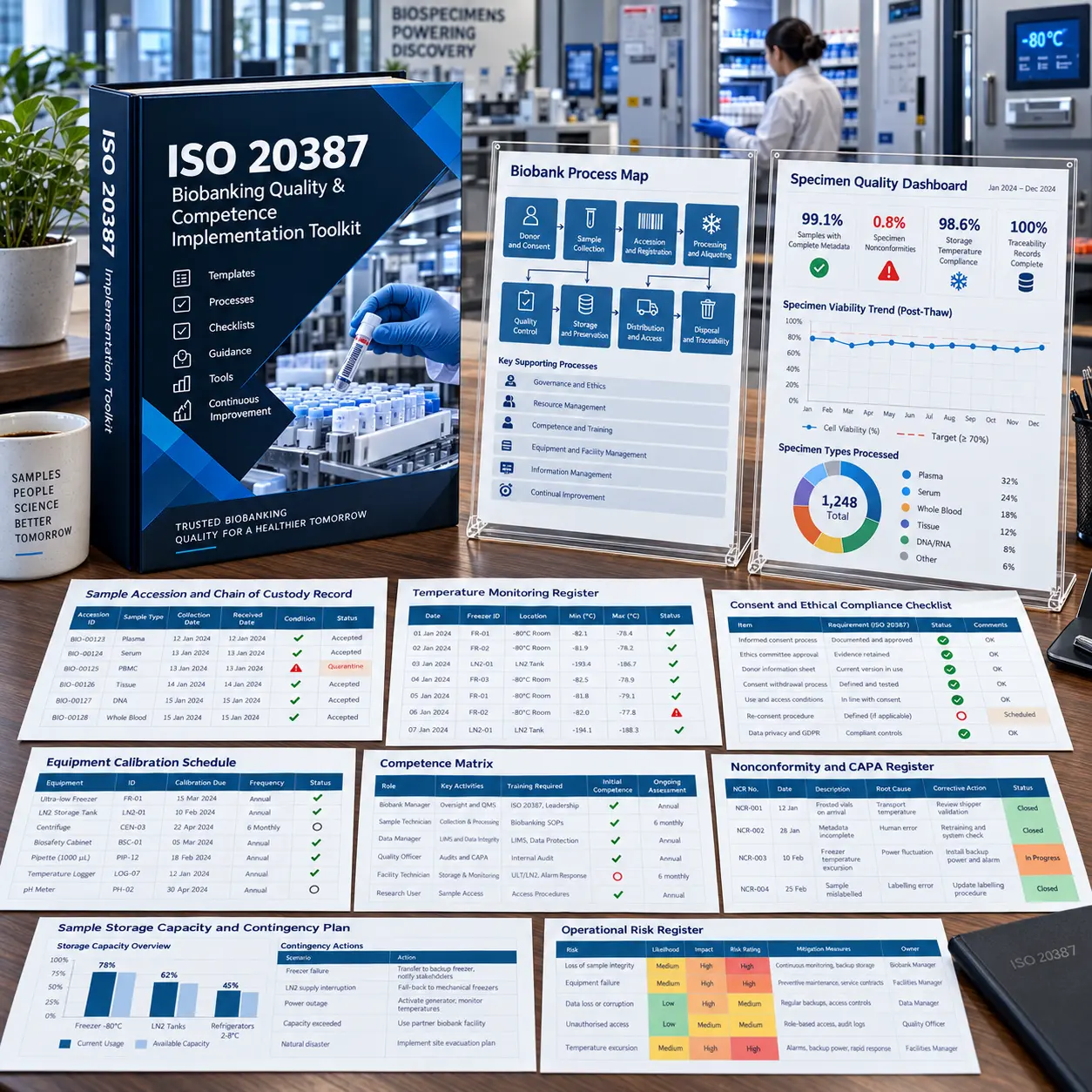
The ISO 20387:2018 Biobanking Quality & Competence Implementation Toolkit provides a comprehensive, easy to use set of premium templates and professionally structured implementation resources to help biobanks establish, document, control, demonstrate, and continually improve competent and consistent biobanking operations.
Aligned with ISO 20387:2018, the toolkit translates biobanking quality and competence requirements into practical policies, procedures, registers, checklists, workbooks, and presentations. It supports governance, impartiality, confidentiality, ethics and consent, personnel competence, facilities and biosafety, equipment qualification, external providers, biological material collection and reception, accessioning and traceability, processing and preservation, quality control, controlled storage, emergency continuity, LIMS and associated data, access and release, distribution, nonconforming material, corrective action, internal audit, management review, and programme closeout.
ISO 20387 Toolkit Value & Pricing
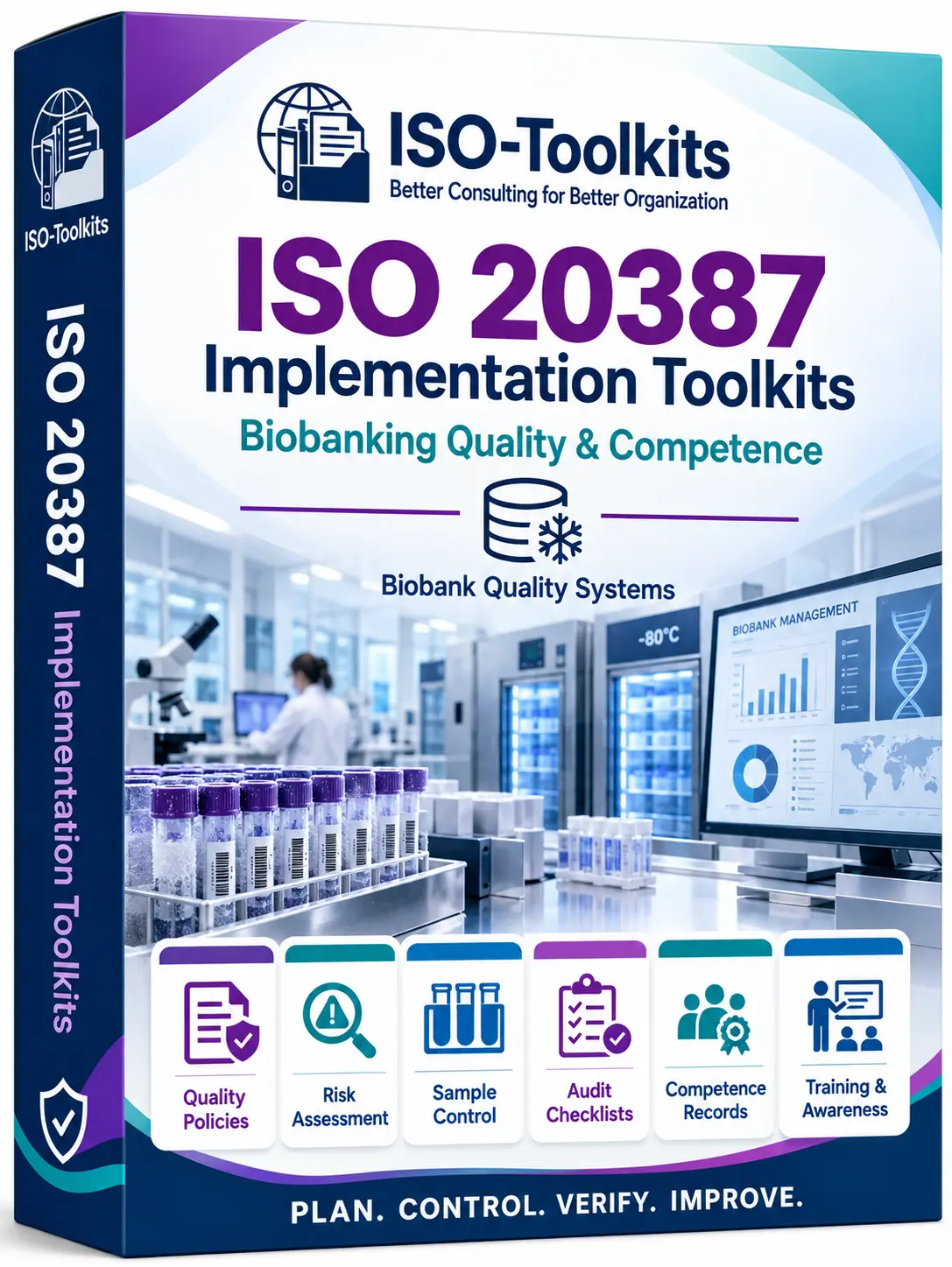
Implementing a biobanking quality and competence framework aligned with ISO 20387:2018 can be demanding because organizations must control biological material and associated data across acquisition, transport, accessioning, processing, characterization, storage, access, distribution, traceability, privacy, equipment, competence, biosafety, external providers, nonconformity, and continual improvement.
The ISO 20387:2018 Biobanking Quality & Competence Implementation Toolkit provides a comprehensive collection of easy to use templates and structured implementation documents in Word, Excel, and PowerPoint formats. It helps biobanks accelerate implementation, standardize documentation, strengthen specimen and data traceability, improve equipment and storage control, formalize competence and governance, and support accreditation preparation with greater efficiency and consistency.

ISO 20387 Toolkit Document Index
Below is the structured list of documents included in the package. Expand each part to review the files before downloading the index file.
 Part 1. Enterprise Biobank Governance and Implementation Initiation
 Enterprise Biobanking Quality Policy.docx ISO 20387 Implementation Charter.docx Biobank Governance and Decision Authority Procedure.docx
 Enterprise Biobank Site and Collection Scope Register.xlsx Biobank Governance RACI Matrix.xlsx ISO 20387 Implementation Roadmap and Action Register.xlsx
 Enterprise ISO 20387 Programme Kickoff.pptx
Part 2. Biobanking Scope, Process Mapping and Gap Assessment
Biobank Accreditation Scope and Applicability Statement.docx Multi Site Biobanking Gap Assessment and Remediation Plan.docx ISO 20387 Requirements and Evidence Matrix.xlsx Biological Material and Associated Data Scope Register.xlsx Biobanking Process and Responsibility Map.xlsx Multi Site ISO 20387 Gap Assessment.xlsx Gap Closure and Investment Tracker.xlsx Biobanking Scope and Readiness Review.pptxPart 3. Impartiality, Confidentiality and Legal Governance
Biobanking Impartiality and Conflict of Interest Procedure.docx Biological Material and Data Confidentiality Procedure.docx Biobank Legal and Regulatory Compliance Procedure.docx Impartiality Risk and Mitigation Register.xlsx Confidentiality Undertaking and Authorized Access Register.xlsx Applicable Biobanking Legal and Regulatory Obligations Matrix.xlsx Conflicts of Interest Declaration and Review Log.xlsx Impartiality Confidentiality and Legal Requirements Review.pptxPart 4. Stakeholder Agreements, Ethics and Consent Management
Biological Material Provider and User Agreement Procedure.docx Human Biospecimen Ethics Consent and Use Restrictions Procedure.docx Biological Material Acquisition and Use Agreement Template.docx Ethics Approval and Consent Applicability Register.xlsx Donor Consent Withdrawal and Use Restriction Tracker.xlsx Provider Recipient and User Agreement Register.xlsx Approved Sample Use and Disclosure Restrictions Matrix.xlsx Biobanking Ethics and Material Use Requirements Workshop.pptxPart 5. Biobank Personnel Competence and Authorization
Biobank Role Competence and Training Procedure.docx Authorized Personnel and Supervision Plan.docx Biobanking Role Based Competence Matrix.xlsx Personnel Qualification Training and Competency Record.xlsx Critical Biobanking Task Authorization Register.xlsx Training Effectiveness and Requalification Tracker.xlsx Biobank Personnel Competence Readiness Review.pptxPart 6. Biobank Facilities, Biosafety and Environmental Conditions
Biobank Facility Biosafety and Environmental Control Procedure.docx Biological Containment and Contamination Prevention Plan.docx Controlled Area Access and Hygiene Procedure.docx Biobank Facility and Biosafety Inspection Checklist.xlsx Biological Material Hazard and Containment Risk Assessment.xlsx Environmental Condition Cleaning and Monitoring Log.xlsx Facility Access and Visitor Authorization Register.xlsx Biobank Facility Biosafety and Containment Review.pptxPart 7. Equipment Qualification, Maintenance and Metrology
Biobanking Equipment Qualification and Lifecycle Procedure.docx Equipment Maintenance Calibration and Release Procedure.docx Biobank Equipment and Instrument Master Register.xlsx Equipment Qualification IQ OQ PQ and Release Checklist.xlsx Preventive Maintenance and Repair History Log.xlsx Calibration and Measurement Traceability Register.xlsx Equipment Failure and Post Repair Release Log.xlsx Biobank Equipment Qualification Readiness Review.pptxPart 8. External Providers, Supplies and Outsourced Activities
Biobank External Provider Approval and Performance Procedure.docx Outsourced Biobanking Activity and Service Agreement.docx Approved External Providers and Critical Supplies Register.xlsx Supplier Qualification and Reassessment Checklist.xlsx Outsourced Process Responsibility and Quality Matrix.xlsx Supplier Nonconformity and Corrective Action Log.xlsx External Provider and Outsourcing Control Review.pptxPart 9. Biological Material Collection and Acquisition
Biological Material Collection and Acquisition Procedure.docx Sample Type Specific Collection and Preanalytical Plan.docx Biological Material Collection Event Record.docx Collection Site Source and Study Register.xlsx Specimen Collection Time Conditions and Handler Log.xlsx Sample Source Eligibility and Collection Checklist.xlsx Collection Deviation and Preanalytical Variability Register.xlsx Biospecimen Collection and Acquisition Workshop.pptxPart 10. Specimen Transportation, Reception and Acceptance
Incoming Biological Material Transport and Reception Procedure.docx Specimen Acceptance Rejection and Quarantine Procedure.docx Incoming Shipment Chain of Custody Register.xlsx Specimen Receiving Condition and Temperature Log.xlsx Specimen Acceptance Identity and Documentation Checklist.xlsx Rejected or Quarantined Specimen Disposition Register.xlsx Biological Material Receiving and Acceptance Review.pptxPart 11. Accessioning, Identification and End-to-End Traceability
Specimen Accessioning Coding and Identifier Control Procedure.docx Biological Material and Metadata Traceability Procedure.docx Biospecimen Unique Identifier and Accession Register.xlsx Source Collection Processing and Aliquot Traceability Matrix.xlsx Specimen Identity Barcode and Label Verification Checklist.xlsx Chain of Custody and Specimen Movement Log.xlsx Biobanking Accessioning and Traceability Review.pptxPart 12. Sample Processing, Aliquoting and Preservation
Biospecimen Processing Aliquoting and Preservation Procedure.docx Preanalytical Time and Condition Control Procedure.docx Processing Method Qualification and Change Control Plan.docx Specimen Processing Batch and Aliquot Record.xlsx Processing Time Temperature and Critical Parameter Log.xlsx Parent Specimen to Aliquot Linkage Matrix.xlsx Preservation Reagent Lot and Equipment Traceability Log.xlsx Processing Deviation and Batch Release Checklist.xlsx Biospecimen Processing and Preservation Control Review.pptxPart 13. Biological Material Characterization and Quality Control
Biological Material Quality Control and Characterization Plan.docx Biobank QC Method Validation and Verification Procedure.docx Specimen Quality Release and Fitness for Purpose Criteria.docx Specimen Identity Purity and Integrity Test Register.xlsx Viability Concentration and Nucleic Acid Quality Log.xlsx Microbial Contamination and Authenticity Test Register.xlsx QC Method Performance and Reference Material Matrix.xlsx Specimen QC Results Trend and Release Decision Register.xlsx Biological Material Quality Control Review.pptxPart 14. Controlled Storage, Cryopreservation and Inventory Management
Biological Material Storage and Cryopreservation Procedure.docx Storage Location Control and Inventory Reconciliation Procedure.docx Freezer Cryotank and Storage Location Master Register.xlsx Storage Temperature Liquid Nitrogen and Alarm Log.xlsx Sample Storage Location and Inventory Movement Register.xlsx Cryogenic Storage Container Integrity and Inspection Checklist.xlsx Periodic Inventory Reconciliation and Missing Sample Log.xlsx Biobank Storage and Inventory Integrity Review.pptxPart 15. Storage Excursions, Emergency Response and Continuity
Biobank Storage Failure and Specimen Rescue Plan.docx Biobank Emergency Response and Business Continuity Procedure.docx Temperature Excursion and Specimen Impact Assessment.xlsx Backup Freezer Cryogen and Power Readiness Checklist.xlsx Emergency Specimen Transfer and Custody Log.xlsx Biobank Incident Drill and Recovery Action Register.xlsx Cryogenic Storage Incident and Continuity Exercise.pptxPart 16. Associated Data, LIMS and Information Security
Biobank LIMS Metadata and Data Governance Procedure.docx Specimen Data Privacy Access and Deidentification Procedure.docx Biobank Record Retention and Data Integrity Procedure.docx Specimen Metadata Dictionary and Mandatory Field Matrix.xlsx LIMS Specimen Processing Storage and Distribution Interface Map.xlsx Personal Data Access Consent and Pseudonymization Register.xlsx Biobank System User Access and Audit Trail Log.xlsx Biological Material to Associated Data Consistency Checklist.xlsx Biobank LIMS and Data Governance Review.pptxPart 17. Biological Material Access, Requests and Release Authorization
Biological Material User Request and Access Review Procedure.docx Specimen Release Authorization and Quality Review Record.docx Material Transfer Agreement MTA Template.docx Biological Material User Request and Approval Register.xlsx Request Eligibility Consent and Use Restriction Checklist.xlsx Specimen Availability QC and Release Decision Matrix.xlsx Biological Material and Data Release Register.xlsx Biobank Material Access and Release Committee Review.pptxPart 18. Packaging, Distribution and External Chain of Custody
Biological Material Packaging Shipping and Distribution Procedure.docx Specimen Dispatch Courier and Recipient Handover Procedure.docx Specimen Packaging and Shipment Readiness Checklist.xlsx Outbound Shipment Temperature and Chain of Custody Log.xlsx Distributed Specimen Aliquot and Recipient Traceability Register.xlsx Courier Excursion Receipt Confirmation and Discrepancy Log.xlsx Specimen Distribution and Chain of Custody Review.pptxPart 19. Nonconforming Material, Recall, Disposal and Corrective Action
Nonconforming Biological Material and Data Control Procedure.docx Specimen Recall Withdrawal and Destruction Procedure.docx Root Cause Corrective Action and Change Control Procedure.docx Nonconforming Specimen and Data Disposition Register.xlsx Specimen Recall and Recipient Notification Tracker.xlsx Biological Material Disposal Destruction and Authorization Log.xlsx Corrective Action Root Cause and Effectiveness Register.xlsx Process Change Risk and Validation Impact Register.xlsx Specimen Nonconformity and Corrective Action Review.pptxPart 20. Internal Audit, Performance Review and Programme Closeout
ISO 20387 Internal Audit and Management Review Procedure.docx Biobank Quality Objectives and Continual Improvement Plan.docx Enterprise Biobanking Implementation Closeout and Handover Plan.docx ISO 20387 Internal Audit and Requirement Checklist.xlsx Biobank Quality Indicators and Performance Dashboard.xlsx Audit Findings Corrective Actions and Closure Register.xlsx Management Review Decisions and Improvement Tracker.xlsx Implementation Closeout and Site Acceptance Checklist.xlsx Enterprise Biobank Management Review and Programme Closeout.pptxReview the complete file index, preview free sample templates, or check the purchase and payment guide.
ISO 20387 Toolkit Package & Download Information
| Date File Updated | 14/08/2024 |
| File Format | doc, docx, xls, xlsx, ppt, pptx |
| No. of files | 160 File; 20 Folders |
| File download size | 3.79 MB (rar). |
| Language |
 English |
| Purchase code | ISO20387-Toolkits |
Ready to Implement ISO 20387:2018?
Start with the complete ISO 20387 biobanking quality and competence toolkit or review the free sample before purchasing.
The ISO 20387 toolkit helped us organize governance, roles, scope, and implementation actions before we started rewriting technical procedures. It gave the team a much clearer programme structure.
The impartiality, confidentiality, ethics, and consent templates were useful because these records had previously been managed separately. We could bring them into one controlled framework.
The competence matrix and critical task authorization register helped us formalize who was qualified to perform specific biobanking activities and when requalification was required.
The equipment qualification, calibration, maintenance, and post repair release records were practical for freezers, monitoring systems, and laboratory instruments.
The accessioning and traceability section was one of the strongest areas. It helped us link source material, processing, aliquots, storage positions, movements, and associated data more consistently.
We used the processing and preservation templates to standardize batch records, critical parameters, reagent lot traceability, deviations, and release checks.
The QC and characterization tools were useful for defining fitness for purpose criteria and documenting identity, integrity, viability, contamination, and release decisions.
The cryogenic storage and emergency continuity section helped us improve freezer failure response, backup capacity checks, specimen transfer records, and excursion impact assessment.
The LIMS and data governance templates gave us a clear method for controlling metadata, user access, audit trails, pseudonymization, and specimen to data consistency.
The material access and release records helped us document user eligibility, consent restrictions, QC status, approvals, and transfer decisions before specimens left the biobank.
The nonconforming material, recall, destruction, root cause, and corrective action tools helped us connect technical specimen issues with the wider quality system.
The internal audit checklist, quality indicators, management review tracker, and closeout documents gave us a structured way to assess readiness and maintain the system after implementation.