
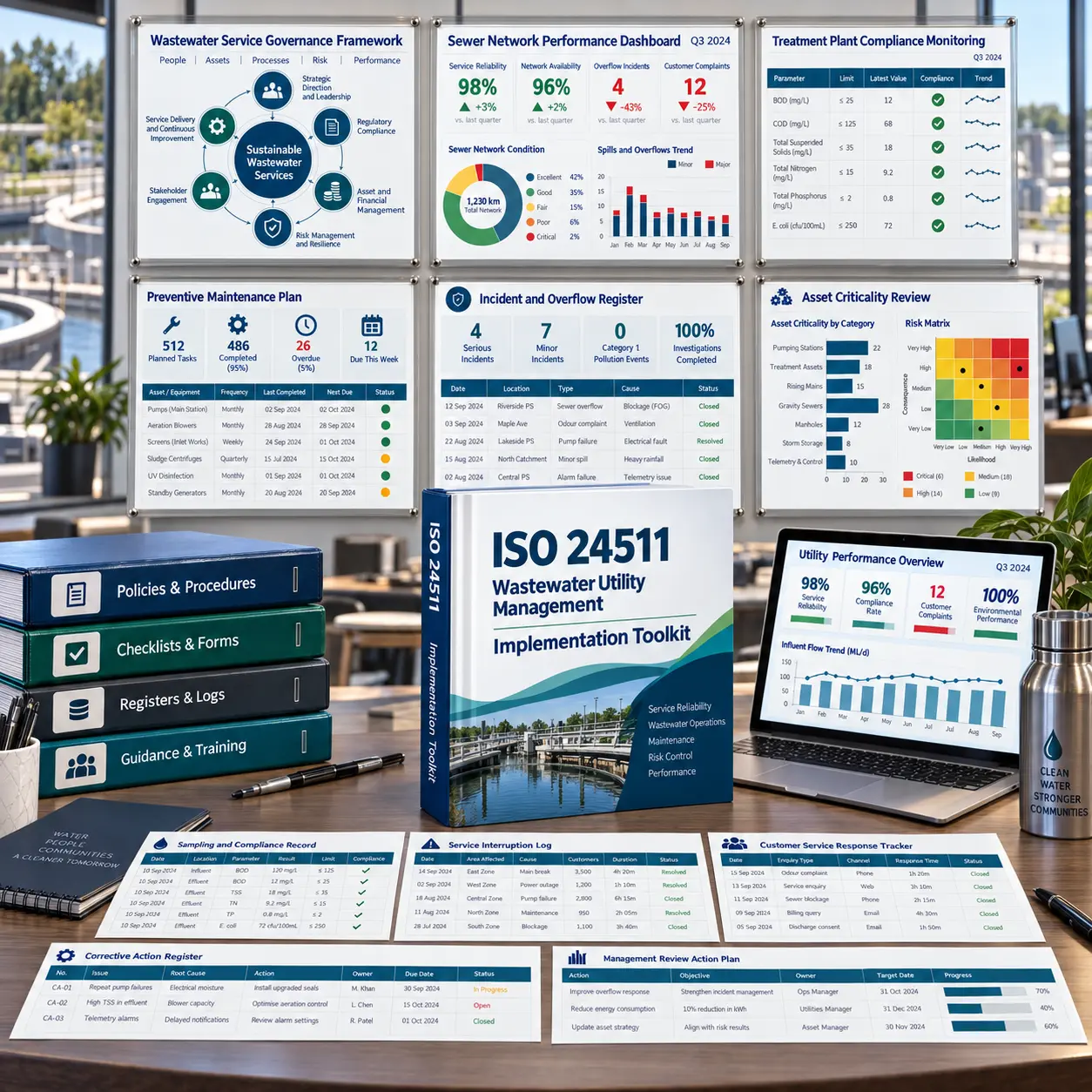
ISO 24511:2024 Wastewater Utility Management Implementation Toolkit
The ISO 24511:2024 Wastewater Utility Management Implementation Toolkit provides a comprehensive, easy to use set of premium templates and professionally structured resources to help wastewater utilities establish, assess, operate, monitor, and improve their wastewater services with stronger governance, service performance, asset reliability, environmental control, and stakeholder focus.
Aligned with ISO 24511:2024, the toolkit translates wastewater utility management and service assessment guidance into practical policies, procedures, registers, matrices, dashboards, checklists, plans, and presentations. It supports utility governance, service scope, stakeholder requirements, performance indicators, catchment and influent control, collection networks, pumping stations, treatment processes, effluent quality and discharge compliance, sludge and biosolids, onsite wastewater services, asset lifecycle management, laboratory testing, workforce competence and safety, customer service, environmental protection, resource efficiency, reuse, emergency preparedness, resilience, internal service assessment, management review, and programme closeout.
ISO 24511 Toolkit Value & Pricing
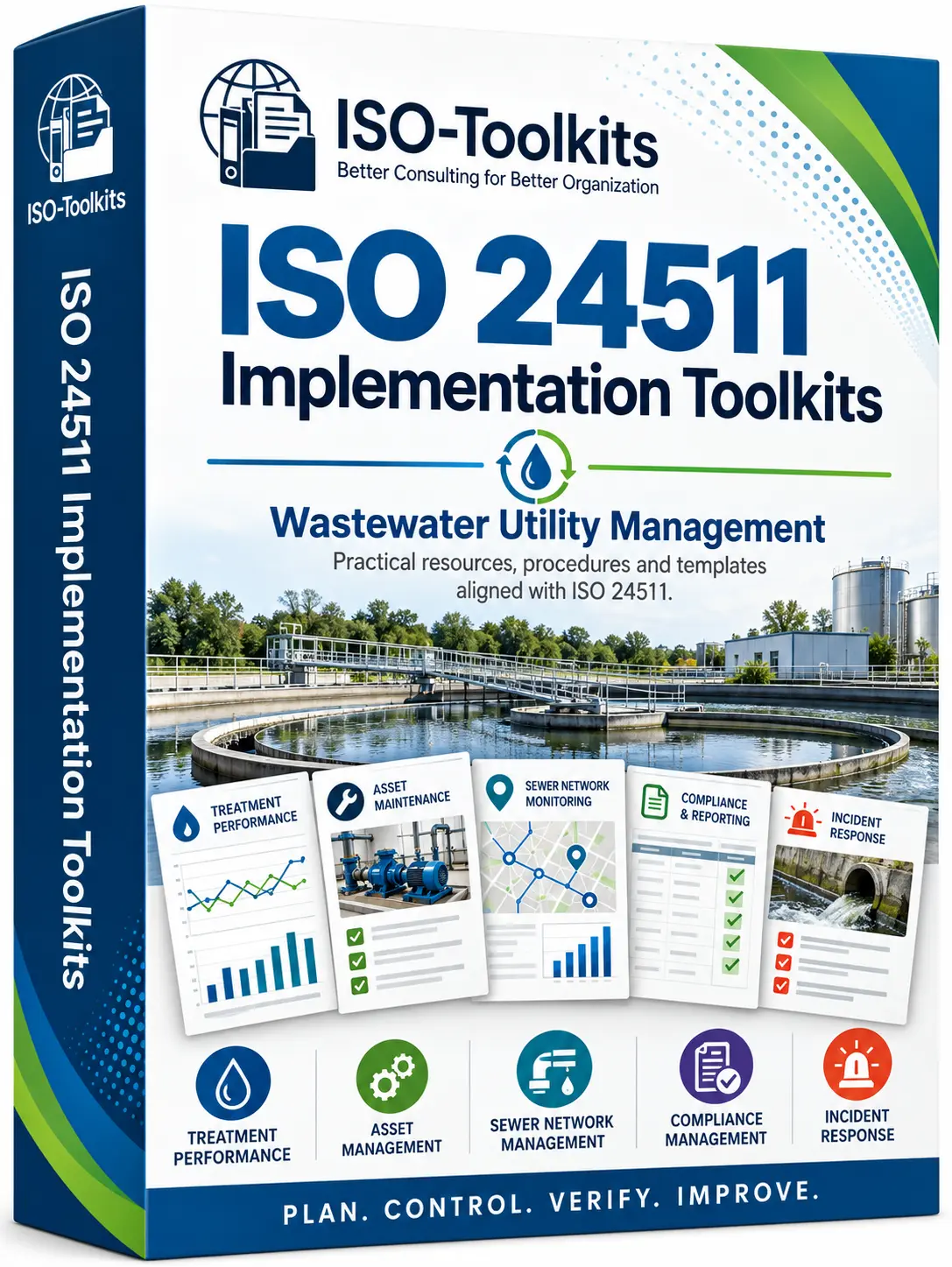
Managing a wastewater utility involves complex interactions between service governance, regulatory obligations, collection systems, pumping, treatment, discharge compliance, sludge management, assets, laboratories, workforce competence, customers, environmental impacts, resource use, emergencies, resilience, and performance assessment. Building consistent documentation across these areas can require substantial time and coordination.
The ISO 24511:2024 Wastewater Utility Management Implementation Toolkit provides a comprehensive collection of easy to use templates and structured implementation documents in Word, Excel, and PowerPoint formats. It helps wastewater utilities accelerate implementation, standardize service management documentation, improve KPI and compliance monitoring, strengthen asset and process reliability, support stakeholder and customer service, and establish a more consistent framework for assessment, management review, resilience, and continual service improvement.

ISO 24511 Toolkit Document Index
Below is the structured list of documents included in the package. Expand each part to review the files before downloading the index file.
 Part 1. Enterprise Wastewater Service Governance and Programme Initiation
 Enterprise Wastewater Service Management Policy.docx ISO 24511 Implementation Charter.docx Wastewater Utility Governance and Accountability Procedure.docx
 Enterprise Wastewater Utility Scope Register.xlsx Utility Governance RACI Matrix.xlsx ISO 24511 Implementation Roadmap and Action Tracker.xlsx
 Enterprise ISO 24511 Programme Kickoff.pptx
Part 2. Service Scope, System Mapping and Gap Assessment
Wastewater Service Scope and System Boundary Statement.docx Multi Site Service Baseline and Gap Assessment Plan.docx ISO 24511 Guidance and Applicability Matrix.xlsx Wastewater Service Asset and Site Inventory.xlsx Service Area and System Interface Register.xlsx Gap Assessment and Remediation Register.xlsx Wastewater Utility Baseline and Gap Review.pptxPart 3. Stakeholder Requirements, Service Obligations and Objectives
Wastewater Stakeholder Engagement and Service Commitments Plan.docx Service Level Objectives and Performance Targets Framework.docx Stakeholder and Service User Register.xlsx Regulatory Permit and Service Obligation Register.xlsx Service Level Objectives and Indicator Matrix.xlsx Service User Needs and Expectations Register.xlsx Stakeholder and Service Level Alignment Workshop.pptxPart 4. Wastewater Service Performance Assessment and KPI Design
Wastewater Performance Assessment Methodology.docx Performance Data Definitions and Reporting Procedure.docx Wastewater Service Objective KPI Register.xlsx KPI Baseline Target and Accountability Matrix.xlsx KPI Data Source Quality and Frequency Matrix.xlsx Performance Assessment and Review Log.xlsx Wastewater KPI Framework Design Review.pptxPart 5. Catchment, Wastewater Sources and Influent Characterization
Catchment and Wastewater Source Management Procedure.docx Industrial Discharge and Receiver Interface Procedure.docx Catchment Source and Discharge Point Register.xlsx Industrial Commercial Influent Risk and Load Assessment.xlsx Flow Load and Influent Characterization Register.xlsx Unauthorized Discharge and Source Investigation Log.xlsx Catchment and Influent Control Review.pptxPart 6. Collection Network Condition, Capacity and Rehabilitation Planning
Wastewater Collection Network Condition Assessment Procedure.docx Sewer Capacity Infiltration and Inflow Evaluation Procedure.docx Sewer Network Condition and Defect Register.xlsx Infiltration Inflow and Surcharge Investigation Log.xlsx Sewer Capacity and Service Coverage Analysis.xlsx Network Rehabilitation and Capital Priority Register.xlsx Sewer Network Condition and Capacity Review.pptxPart 7. Collection Network Operation, Maintenance and Overflow Control
Sewer Network Operation and Maintenance Procedure.docx Blockage Overflow and Cleaning Response Procedure.docx Sewer Cleaning and Preventive Maintenance Schedule.xlsx Blockage and Sewer Backup Incident Log.xlsx Sewer CCTV Inspection and Repair Tracker.xlsx Network Service Disruption and Response Time Register.xlsx Network Operations and Maintenance Review.pptxPart 8. Pumping Stations and Wastewater Conveyance
Wastewater Pumping Station Operation Procedure.docx Pumping Station Emergency Bypass and Failure Response Procedure.docx Pumping Station Daily Inspection and Run Hours Log.xlsx Pump Performance and Energy Consumption Tracker.xlsx Wet Well Overflow Alarm and Response Register.xlsx Pumping Station Maintenance and Reliability Schedule.xlsx Pumping and Conveyance Service Review.pptxPart 9. Treatment Plant Inlet and Preliminary Treatment
Treatment Plant Inlet and Preliminary Treatment Procedure.docx Treatment Unit Operating Limits and Escalation Procedure.docx Influent Flow and Load Monitoring Log.xlsx Screen Grit and Primary Settlement Operation Log.xlsx Preliminary Treatment Byproduct Disposal Register.xlsx Inlet Abnormal Load and Process Deviation Register.xlsx Treatment Plant Inlet Readiness Review.pptxPart 10. Biological, Chemical and Advanced Treatment Process Control
Wastewater Treatment Process Operation and Control Procedure.docx Process Upset Investigation and Recovery Procedure.docx Biological Process Parameters and Control Log.xlsx Chemical Dosing and Residual Control Register.xlsx Secondary and Advanced Treatment Performance Tracker.xlsx Process Upset and Corrective Action Register.xlsx Treatment Process Performance Review.pptxPart 11. Effluent Quality, Discharge Compliance and Environmental Reporting
Effluent Quality Control and Discharge Compliance Procedure.docx Noncompliant Discharge Notification and Response Procedure.docx Effluent Monitoring and Legal Limit Matrix.xlsx Effluent Sampling Testing and Results Register.xlsx Discharge Compliance Deviation and Report Log.xlsx Effluent Quality Trend and Load Analysis.xlsx Effluent Quality and Discharge Compliance Review.pptxPart 12. Sludge, Biosolids, Residuals and Odour Management
Sludge Biosolids and Residuals Management Procedure.docx Sludge Transport Treatment and Final Disposition Procedure.docx Sludge Production Handling and Storage Log.xlsx Biosolids Quality and Reuse Suitability Register.xlsx Sludge Transport Manifest and Disposal Tracker.xlsx Odour and Residuals Complaint Register.xlsx Sludge and Biosolids Management Review.pptxPart 13. Onsite Wastewater and Septage Services – Where Applicable
Onsite Sanitation and Septage Service Management Procedure.docx Septage Collection Transport and Acceptance Procedure.docx Onsite System and Service Provider Register.xlsx Septage Collection Transfer and Receiving Log.xlsx Onsite System Inspection and Desludging Schedule.xlsx Septage Discharge Point and Deviation Register.xlsx Onsite Wastewater Service Review.pptxPart 14. Wastewater Asset Reliability, Maintenance and Lifecycle Planning
Wastewater Asset Management and Lifecycle Plan.docx Critical Asset Reliability and Replacement Procedure.docx Wastewater Critical Asset and Condition Register.xlsx Asset Failure Risk and Service Criticality Matrix.xlsx Planned Preventive and Corrective Maintenance Tracker.xlsx Asset Replacement Capital and Whole Life Cost Register.xlsx Wastewater Asset Reliability and Investment Review.pptxPart 15. Monitoring, Laboratory Testing and Data Integrity
Wastewater Sampling Testing and Data Quality Procedure.docx Online Instrumentation Calibration and Data Validation Procedure.docx Wastewater Sampling Plan and Chain of Custody Log.xlsx Laboratory Test Result and Quality Control Register.xlsx Monitoring Instrument Calibration and Verification Log.xlsx Monitoring Data Completeness and Outlier Investigation.xlsx Monitoring and Data Quality Review.pptxPart 16. Workforce Competence, Operational Safety and Contractor Control
Wastewater Operations Competence and Training Plan.docx Operational Safety and Contractor Control Procedure.docx Wastewater Role Based Competence Matrix.xlsx Operator Authorization and Refresher Training Register.xlsx Contractor Qualification and Service Performance Assessment.xlsx High Risk Work Permit and Incident Tracking Register.xlsx Workforce Competence and Contractor Readiness Review.pptxPart 17. Customer Service, Service Continuity and Public Communications
Wastewater Customer Service and Complaint Procedure.docx Service Interruption Notification and Communication Procedure.docx Customer Service Request and Complaint Register.xlsx Service Interruption Notification and Response Log.xlsx Customer Satisfaction and Feedback Analysis.xlsx Community Engagement and Stakeholder Action Tracker.xlsx Wastewater Customer Service Performance Review.pptxPart 18. Environmental Protection, Resource Efficiency and Reuse
Environmental Impact Odour and Nuisance Control Procedure.docx Wastewater Resource Recovery and Effluent Reuse Plan.docx Environmental Aspect Impact and Control Register.xlsx Odour Noise and Public Nuisance Monitoring Log.xlsx Energy Water and Chemical Use Efficiency Dashboard.xlsx Reclaimed Water Reuse and Byproduct Quality Register.xlsx Wastewater Environmental and Resource Review.pptxPart 19. Emergency Preparedness, Extreme Weather and Service Resilience
Wastewater Emergency Response and Business Continuity Plan.docx Flood Storm Power Loss and Overflow Contingency Procedure.docx Utility Emergency Scenario and Response Responsibility Matrix.xlsx Sewer Overflow and Flood Event Register.xlsx Emergency Equipment Backup Power Readiness Checklist.xlsx Emergency Exercise Debrief and Corrective Action Register.xlsx Wastewater Utility Resilience and Emergency Exercise.pptxPart 20. Internal Service Assessment, Management Review and Programme Closeout
Wastewater Service Internal Assessment and Management Review Procedure.docx ISO 24511 Implementation Closeout and Sustainment Plan.docx ISO 24511 Service Assessment Checklist.xlsx Wastewater Service KPI and Improvement Dashboard.xlsx Service Deviation Corrective Action and Improvement Register.xlsx Enterprise Implementation Closeout and Acceptance Checklist.xlsx Enterprise Wastewater Service Management Review and Closeout.pptxReview the complete file index, preview free sample templates, or check the purchase and payment guide.
ISO 24511 Toolkit Package & Download Information
| Date File Updated | 23/06/2024 |
| File Format | doc, docx, xls, xlsx, ppt, pptx |
| No. of files | 107 File; 10 Folders |
| File download size | 10.12 MB (rar). |
| Language |
 English |
| Purchase code | ISO24511-Toolkits |
Ready to Strengthen Wastewater Utility Management with ISO 24511?
Start with the complete ISO 24511 wastewater utility management toolkit or review the free sample before purchasing.
The ISO 24511 toolkit helped us organize wastewater service management around governance, service objectives, operations, performance, and improvement instead of treating each department separately.
The service scope, system boundary, stakeholder, permit, and service level templates made our utility baseline review much more systematic.
The catchment, industrial discharge, influent characterization, and unauthorized discharge records helped us strengthen source control investigations.
The sewer condition, infiltration, capacity, CCTV, blockage, overflow, and rehabilitation templates were practical for connecting network operations with capital planning.
The pumping station inspection, run hours, energy, alarm, maintenance, and reliability records helped our operations team standardize daily and monthly reviews.
The treatment process, chemical dosing, biological performance, process upset, corrective action, and recovery tools were useful for plant operating discipline.
The effluent compliance and laboratory sections helped us connect sampling, legal limits, results, deviations, calibration, data quality, and trend analysis.
The sludge, biosolids, residuals, odour, transport, reuse suitability, and disposal records gave us a much clearer control framework.
The asset criticality, condition, maintenance, replacement, lifecycle cost, and investment tools helped us prioritize reliability actions more consistently.
The customer service, interruption notification, public communication, community engagement, and feedback templates improved our service facing processes.
The environmental impact, resource recovery, reclaimed water reuse, energy, water, chemical, odour, and nuisance tools supported a broader view of utility performance.
The emergency, flood, power loss, overflow, internal assessment, KPI, corrective action, management review, and closeout templates gave us a clear sustainment framework.