
ISO 26262:2018 Automotive Functional Safety Implementation Toolkit
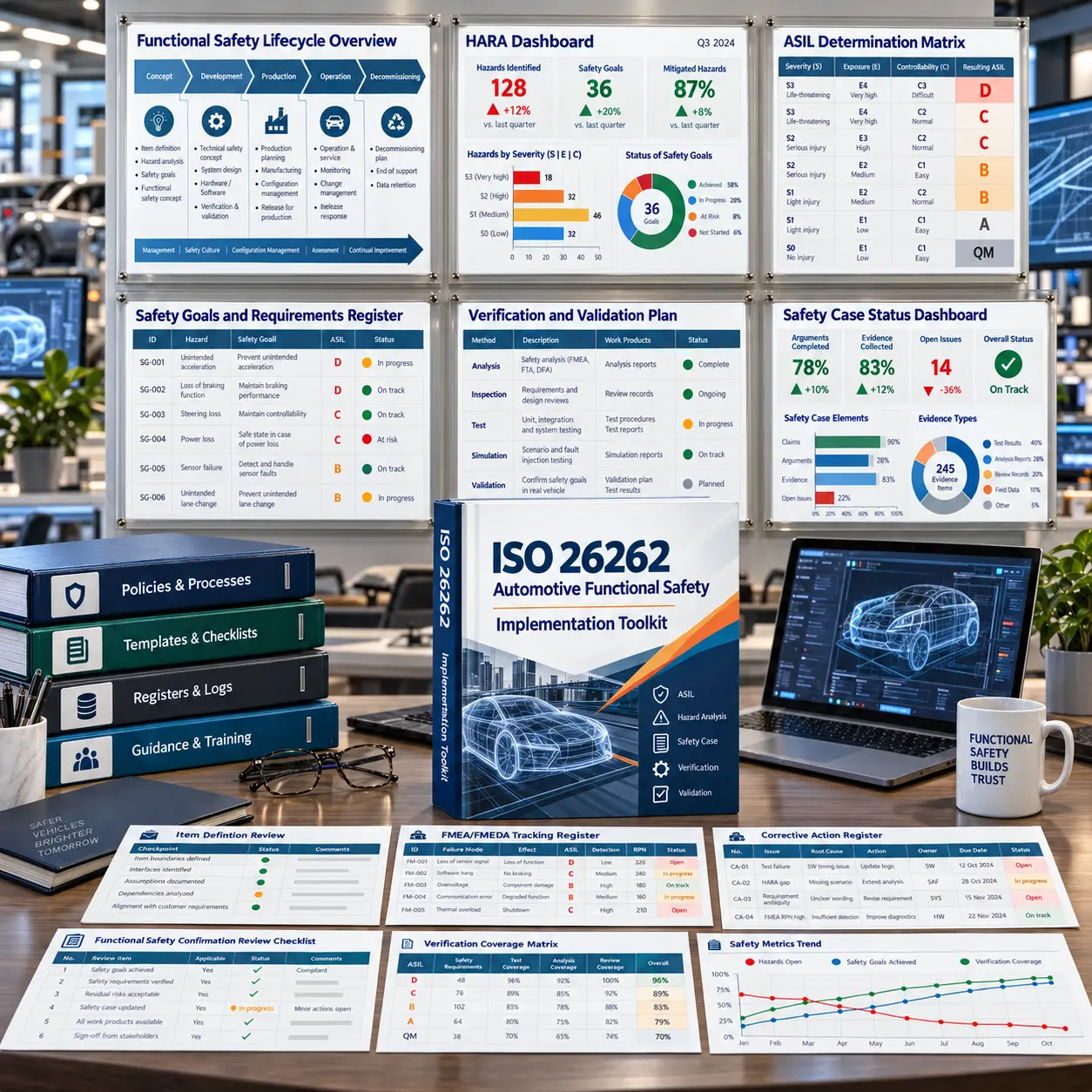
The ISO 26262:2018 Automotive Functional Safety Implementation Toolkit provides a comprehensive, easy to use set of premium templates and professionally structured implementation resources to help automotive organizations establish, manage, document, verify, and sustain functional safety activities across the safety lifecycle.
Aligned with the ISO 26262:2018 series, Parts 1 to 12, the toolkit translates automotive functional safety requirements and guidance into practical policies, procedures, specifications, registers, matrices, workbooks, checklists, reports, and presentations. It supports functional safety governance, lifecycle planning, item definition, HARA, ASIL classification, functional and technical safety concepts, system architecture, hardware safety, FMEDA and hardware safety metrics, fault injection, software safety development and verification, ASIL decomposition, semiconductor and motorcycle considerations, requirements and configuration management, tool confidence, component qualification, distributed development, SEooC integration, vehicle level validation, confirmation measures, functional safety assessment, safety case development, production controls, field monitoring, service, decommissioning, competence, management review, and programme closeout.
ISO 26262 Toolkit Value & Pricing
Implementing ISO 26262 requires coordinated work across concept, system, hardware, software, production, operation, service, and decommissioning. Organizations must maintain consistent safety plans, analyses, requirements, traceability, verification evidence, supplier interfaces, confirmation measures, safety cases, and release decisions across a complex automotive development lifecycle.
The ISO 26262:2018 Automotive Functional Safety Implementation Toolkit provides a comprehensive collection of easy to use templates and structured implementation documents in Word, Excel, and PowerPoint formats. It helps automotive organizations accelerate functional safety implementation, standardize lifecycle work products, strengthen HARA and ASIL evidence, improve system, hardware, and software traceability, coordinate supplier deliverables, support functional safety assessment, and maintain stronger evidence for safety case, release, production, field monitoring, and lifecycle closeout.

ISO 26262 Toolkit Document Index
Below is the structured list of documents included in the package. Expand each part to review the files before downloading the index file.
 Part 1. Enterprise Functional Safety Governance and Programme Initiation
 Enterprise Functional Safety Policy.docx ISO 26262 Implementation Charter.docx Functional Safety Management System Procedure.docx
 ISO 26262 Organizational Readiness and Gap Assessment.xlsx Enterprise Functional Safety RACI Matrix.xlsx Functional Safety Implementation Roadmap and Action Register.xlsx
 Enterprise Functional Safety Programme Kickoff.pptx
Part 2. Safety Lifecycle Planning, Applicability and Tailoring
Item Functional Safety Management Plan.docx ISO 26262 Applicability and Lifecycle Tailoring Procedure.docx Confirmation Measures and Independence Plan.docx ISO 26262 Part and Requirement Applicability Matrix.xlsx Safety Lifecycle Work Product and Milestone Register.xlsx Functional Safety Plan Deliverables and Responsibility Tracker.xlsx Safety Lifecycle Planning and Tailoring Review.pptxPart 3. Item Definition and Operating Context
Automotive Item Definition.docx Item Functions Boundaries and Interfaces Specification.docx Item Functions and Operating Modes Register.xlsx Vehicle Operating Scenarios and Environmental Conditions Matrix.xlsx Item Interfaces Assumptions and Dependencies Register.xlsx Item Definition and Operating Context Workshop.pptxPart 4. Hazard Analysis, Risk Assessment and ASIL Classification
Hazard Analysis and Risk Assessment Procedure.docx HARA Results and Safety Goals Report.docx Malfunctioning Behaviour and Hazard Identification Register.xlsx Hazardous Event Severity Exposure Controllability Assessment.xlsx ASIL Classification and Safety Goal Register.xlsx HARA Assumptions Review and Approval Log.xlsx HARA and ASIL Assessment Workshop.pptxPart 5. Functional Safety Concept and Safety Goals
Functional Safety Concept.docx Safe State and Emergency Operation Concept.docx Functional Safety Requirements Register.xlsx Safety Goal to Functional Safety Requirement Traceability.xlsx Fault Reaction and Fault Tolerant Time Interval Matrix.xlsx Functional Safety Concept Verification Checklist.xlsx Functional Safety Concept Review.pptxPart 6. Technical Safety Concept and System Safety Requirements
Technical Safety Concept.docx Technical Safety Requirements Specification.docx System Safety Mechanisms and Interface Specification.docx Functional to Technical Safety Requirements Traceability.xlsx Technical Safety Requirement ASIL and Allocation Matrix.xlsx Safety Mechanism Diagnostic and Fault Response Register.xlsx Technical Safety Concept Verification Register.xlsx Technical Safety Concept Approval Review.pptxPart 7. System Architecture, Integration and Safety Engineering
Safety Related System Architecture Design.docx System Integration and Test Plan.docx System Safety Requirement to Element Allocation Matrix.xlsx System Interfaces and Integration Dependency Register.xlsx System Integration Test Cases and Results.xlsx System Architecture Safety Review Checklist.xlsx System Architecture and Integration Review.pptxPart 8. Hardware Safety Requirements and Architectural Design
Hardware Safety Requirements Specification.docx Safety Related Hardware Architecture Design.docx Technical to Hardware Safety Requirement Traceability.xlsx Hardware Element ASIL and Safety Mechanism Allocation.xlsx Hardware Safety Design Review Checklist.xlsx Hardware Component Failure Rate and Data Source Register.xlsx Hardware Safety Architecture Review.pptxPart 9. Hardware Failure Analysis and Safety Metrics
Hardware Random Failure Analysis Plan.docx Hardware Safety Metrics and Residual Risk Report.docx Hardware FMEDA and Failure Mode Classification.xlsx Single Point Fault Metric SPFM Calculation.xlsx Latent Fault Metric LFM Calculation.xlsx Probabilistic Metric for Random Hardware Failures PMHF.xlsx Hardware Failure Rate Assumptions and Evidence Register.xlsx Hardware Safety Metrics and FMEDA Review.pptxPart 10. Hardware Integration, Verification and Fault Injection
Hardware Integration and Verification Plan.docx Hardware Fault Injection Test Procedure.docx Hardware Requirements Verification Matrix.xlsx Hardware Integration Test Cases and Results.xlsx Hardware Fault Injection Coverage and Results Log.xlsx Hardware Design Defect and Retest Register.xlsx Hardware Verification and Fault Injection Review.pptxPart 11. Software Safety Requirements and Architecture
Software Safety Requirements Specification.docx Software Safety Architecture Design.docx Software Safety Development and Verification Plan.docx Technical to Software Safety Requirement Traceability.xlsx Software ASIL Allocation and Architectural Segregation Matrix.xlsx Software Safety Mechanism and Interface Register.xlsx Software Architecture Verification Checklist.xlsx Software Safety Architecture Review.pptxPart 12. Software Unit Design, Implementation and Coding Controls
Software Unit Design and Implementation Procedure.docx Safety Related Software Coding Guidelines.docx Software Unit Design and Safety Requirement Mapping.xlsx Software Static Analysis and Coding Compliance Log.xlsx Software Unit Complexity and Design Review Checklist.xlsx Software Code Review Findings and Resolution Register.xlsx Software Unit Design and Code Quality Review.pptxPart 13. Software Unit Verification, Integration and Embedded Testing
Software Unit Integration and Test Plan.docx Embedded Software Test and Verification Procedure.docx Software Unit Test Cases and Results.xlsx Software Structural Coverage and Justification Register.xlsx Software Integration Test Cases and Results.xlsx Embedded Software Requirements Test Matrix.xlsx Software Test Anomaly and Retest Register.xlsx Software Verification and Test Coverage Review.pptxPart 14. ASIL Decomposition and Safety Oriented Analyses
ASIL Decomposition and Independence Justification.docx Safety Oriented Analysis and Dependent Failure Procedure.docx ASIL Decomposition and Allocation Matrix.xlsx Fault Tree Analysis FTA Worksheet.xlsx Failure Mode and Effects Analysis FMEA Register.xlsx Dependent Failure Analysis DFA Register.xlsx Safety Analysis Assumptions and Mitigation Tracker.xlsx Safety Analyses and ASIL Decomposition Review.pptxPart 15. Semiconductor Functional Safety Engineering (Where Applicable)
Semiconductor Safety Analysis and Application Guideline.docx Semiconductor Safety Manual.docx Semiconductor Safety Element and Assumption Register.xlsx Semiconductor Failure Modes Diagnostics and FMEDA.xlsx Semiconductor Dependent Failure and Common Cause Analysis.xlsx Semiconductor Safety Requirement and Evidence Matrix.xlsx Semiconductor Safety Evidence Review.pptxPart 16. Motorcycle Functional Safety Adaptation (Where Applicable)
Motorcycle ISO 26262 Adaptation and Tailoring Plan.docx Motorcycle Functional Safety Concept Review Record.docx Motorcycle HARA and MSIL Assessment.xlsx Motorcycle Adapted Requirements and Confirmation Matrix.xlsx Motorcycle Integration Test and Safety Validation Register.xlsx Motorcycle Functional Safety Adaptation Review.pptxPart 17. Safety Requirements, Configuration and Change Management
Safety Requirements Management and Traceability Procedure.docx Configuration Change and Impact Management Procedure.docx End to End Safety Requirement Traceability Matrix.xlsx Safety Work Product Configuration and Baseline Register.xlsx Safety Related Change Request and Impact Assessment.xlsx Safety Requirements Change Approval and Verification Log.xlsx Safety Requirements and Change Control Board.pptxPart 18. Tool Confidence, Component Qualification and Proven In Use
Software Tool Confidence and Qualification Procedure.docx Pre Existing Component Qualification and Reuse Plan.docx Proven In Use Argument and Evidence Report.docx Software Tool Impact and Error Detection Assessment.xlsx Tool Confidence Level TCL and Qualification Register.xlsx Software Component Qualification Evidence Checklist.xlsx Hardware Element Evaluation and Qualification Checklist.xlsx Proven In Use Operational Evidence and Failure Rate Register.xlsx Tool and Component Qualification Review.pptxPart 19. Distributed Development, Suppliers and SEooC Integration
Distributed Development Interface Agreement DIA.docx Supplier Functional Safety Requirements and Evidence Plan.docx Safety Element Out of Context SEooC Assumptions and Integration Plan.docx OEM Tier Supplier Safety Responsibility Matrix.xlsx Supplier Safety Work Product and Delivery Register.xlsx SEooC Assumptions Of Use and Integration Verification Matrix.xlsx Supplier Safety Issue and Escalation Register.xlsx Supplier and Distributed Development Safety Review.pptxPart 20. End to End Verification, Vehicle Integration and Safety Validation
System Level Safety Verification and Validation Plan.docx Vehicle Level Safety Validation Procedure.docx Safety Goal and Safety Requirement Verification Coverage.xlsx Vehicle Integration and Fault Response Test Register.xlsx Safety Validation Scenarios and Test Results.xlsx Residual Test Anomaly and Safety Impact Register.xlsx Vehicle Safety Validation Results Review.pptxPart 21. Confirmation Reviews, Functional Safety Assessment and Safety Case
Functional Safety Audit and Confirmation Review Procedure.docx Functional Safety Assessment Report.docx Functional Safety Case and Release Recommendation.docx ASIL Based Confirmation Measures and Independence Matrix.xlsx Functional Safety Audit and Assessment Checklist.xlsx Safety Work Product Review and Approval Register.xlsx Safety Case Claim Argument Evidence Matrix.xlsx Open Safety Findings and Release Action Register.xlsx Functional Safety Assessment and Release Gate.pptxPart 22. Production, Manufacturing and End of Line Safety Controls
Safety Related Production and Control Plan.docx Manufacturing Safety Critical Characteristic Control Procedure.docx End of Line Functional Safety Test and Release Procedure.docx Safety Critical Manufacturing Characteristic Control Matrix.xlsx Production Process Change and Safety Impact Register.xlsx End of Line Safety Test Results and Release Log.xlsx Production Safety Nonconformity and Containment Register.xlsx Production Functional Safety Readiness Review.pptxPart 23. Operation, Service, Field Monitoring and Decommissioning
Operation and Service Functional Safety Information Plan.docx Field Safety Incident and Corrective Action Procedure.docx Safety Related Service and Decommissioning Procedure.docx Field Safety Incident and Malfunction Trend Register.xlsx Service Repair and Safety Configuration Record.xlsx Field Change Recall and Safety Impact Tracker.xlsx Decommissioning and Safety Critical Disposal Checklist.xlsx Field Safety Performance and Service Review.pptxPart 24. Competence, Management Review and Programme Closeout
Functional Safety Competence and Training Plan.docx Enterprise Functional Safety Management Review Procedure.docx ISO 26262 Implementation Closeout and Sustainment Plan.docx Functional Safety Role Competence and Training Matrix.xlsx Functional Safety KPI and Work Product Compliance Dashboard.xlsx Audit Findings Corrective Actions and Lessons Learned Register.xlsx Implementation Closeout and Lifecycle Handover Checklist.xlsx Enterprise Functional Safety Management Review and Closeout.pptxReview the complete file index, preview free sample templates, or check the purchase and payment guide.
ISO 26262 Toolkit Package & Download Information
| Date File Updated | 08/03/2023 |
| File Format | doc, docx, xls, xlsx, ppt, pptx |
| No. of files | 107 File; 10 Folders |
| File download size | 10.12 MB (rar). |
| Language |
 English |
| Purchase code | ISO26262-Toolkits |
Ready to Strengthen Automotive Functional Safety with ISO 26262?
Start with the complete ISO 26262 automotive functional safety toolkit or review the free sample before purchasing.
The ISO 26262 toolkit helped us structure functional safety work products around the lifecycle instead of managing system, hardware, software, and supplier evidence separately.
The item definition, operating context, HARA, ASIL, safety goals, and assumptions templates made our concept phase reviews much more systematic.
The functional and technical safety requirement traceability tools helped us maintain clearer links between safety goals, allocation, mechanisms, and verification.
The hardware requirements, FMEDA, SPFM, LFM, PMHF, failure rate evidence, and fault injection records were practical for our electronics development process.
The software architecture, coding, static analysis, unit test, structural coverage, integration, and anomaly templates gave our embedded team a consistent evidence set.
The ASIL decomposition, FTA, FMEA, DFA, common cause, and mitigation records made safety analysis assumptions much easier to review.
The semiconductor safety manual, application assumptions, FMEDA, diagnostics, and evidence matrix were especially useful for supplier integration.
The configuration, baseline, change impact, safety requirement, approval, and verification logs strengthened our change control process.
The tool confidence, component qualification, proven in use, and reuse templates helped our teams document qualification decisions more consistently.
The DIA, supplier responsibility matrix, SEooC assumptions, supplier work product register, and escalation tools fit well with distributed automotive development.
The vehicle integration, safety validation, confirmation review, assessment, safety case, and release gate documents gave us a stronger final assurance process.
The production, end of line, field monitoring, service, recall, decommissioning, competence, KPI, management review, and closeout templates gave us a clear lifecycle sustainment framework.