
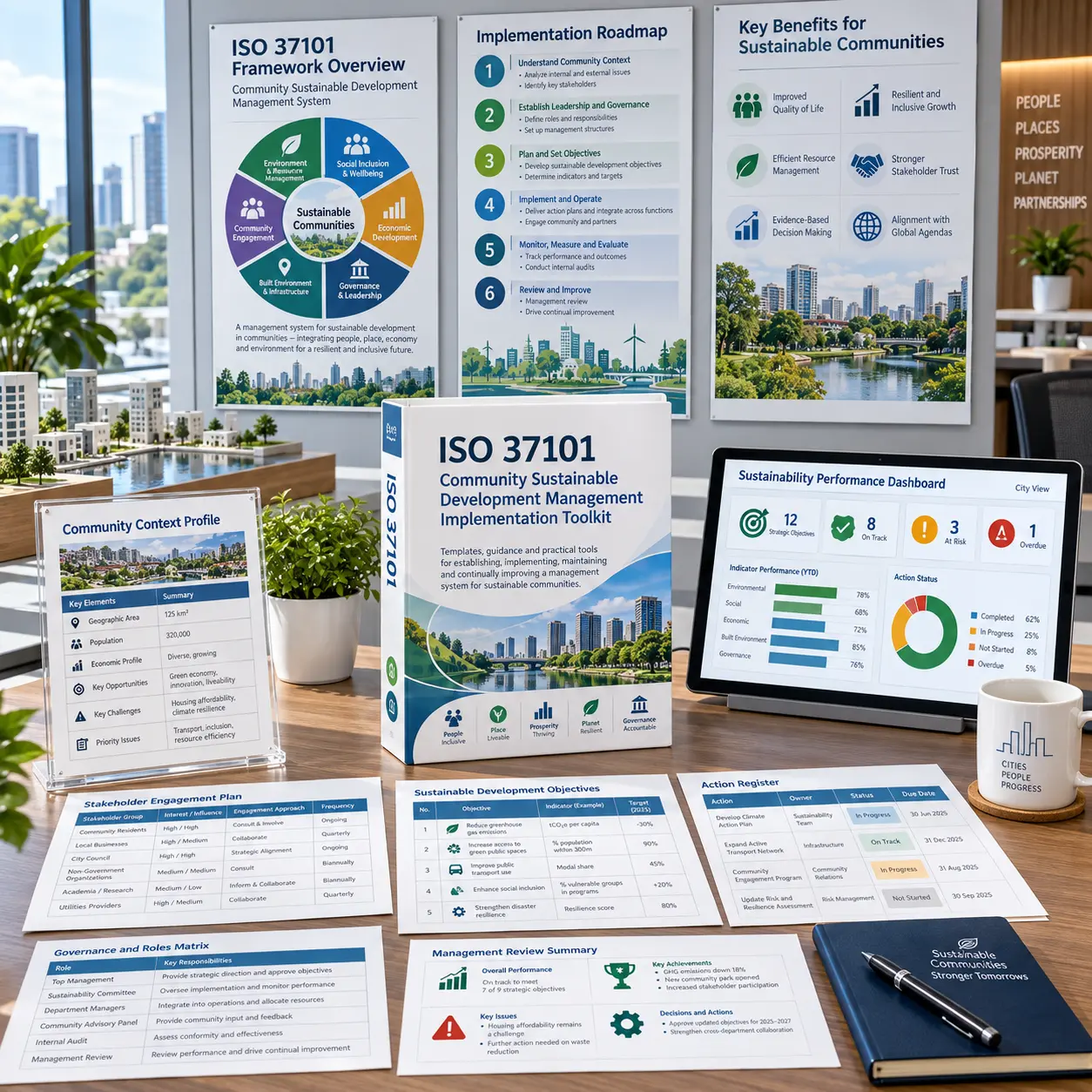
ISO 37101:2016 Sustainable Development in Communities Implementation Toolkit
The ISO 37101:2016 Sustainable Development in Communities Implementation Toolkit provides a comprehensive, easy to use set of premium templates and professionally structured implementation resources to help communities and designated organizations establish, operate, monitor, and continually improve a management system for sustainable development.
Aligned with ISO 37101:2016 and Amendment 1:2024 climate action changes, the toolkit translates sustainable community management requirements into practical policies, procedures, registers, matrices, dashboards, checklists, plans, and presentations. It supports community governance, territorial scope, compliance obligations, stakeholder and citizen engagement, the six sustainability purposes and twelve sustainability issues, baseline assessment, leadership, strategic planning, climate risk and resilience, participatory governance, education and innovation, health and social cohesion, local economic development, land use and housing, community safety, infrastructure and essential services, sustainable mobility, biodiversity, energy and resource efficiency, project portfolio delivery, partner coordination, performance monitoring, public reporting, internal audit, management review, and programme handover.
ISO 37101 Toolkit Value & Pricing
Implementing a community sustainability management system can be demanding because effective sustainable development requires coordination across governance, stakeholders, climate action, resilience, social inclusion, local economy, housing, public space, safety, infrastructure, mobility, biodiversity, energy, water, materials, projects, partner organizations, data assurance, public reporting, and continual improvement.
The ISO 37101:2016 Sustainable Development in Communities Implementation Toolkit provides a comprehensive collection of easy to use templates and structured implementation documents in Word, Excel, and PowerPoint formats. It helps communities and designated organizations accelerate implementation, standardize sustainability governance, integrate climate action and resilience, strengthen stakeholder participation, coordinate programmes and partners, and maintain stronger evidence for monitoring, public reporting, internal audit, management review, and continual improvement.

ISO 37101 Toolkit Document Index
Below is the structured list of documents included in the package. Expand each part to review the files before downloading the index file.
 Part 1. Enterprise Sustainable Community Governance and Programme Initiation
 Enterprise Community Sustainable Development Policy.docx ISO 37101 Implementation Charter.docx Community Sustainability Management Roles and Authority Procedure.docx
 Community Organizations Territories and Site Scope Register.xlsx Sustainable Development Governance RACI Matrix.xlsx ISO 37101 Implementation Roadmap and Action Tracker.xlsx
 Enterprise ISO 37101 Implementation Kickoff.pptx
Part 2. Community Context, Territorial Boundaries and Compliance Obligations
Community Context and Territorial Scope Statement.docx Sustainability Compliance Obligations and Applicability Procedure.docx ISO 37101 Requirements and Evidence Matrix.xlsx Community Territorial Boundary and Administrative Interface Register.xlsx Legal Regulatory and Sustainability Commitment Register.xlsx Context Climate Relevance and External Trend Assessment.xlsx Community Context and Compliance Review.pptxPart 3. Interested Parties, Citizen Engagement and Stakeholder Expectations
Community Stakeholder Engagement and Consultation Plan.docx Community Needs and Expectations Assessment Procedure.docx Interested Parties and Community Stakeholder Register.xlsx Stakeholder Influence Inclusion and Engagement Matrix.xlsx Community Consultation Feedback and Commitment Log.xlsx Stakeholder Needs to Sustainability Requirement Matrix.xlsx Community Stakeholder Engagement Workshop.pptxPart 4. Six Sustainability Purposes and Twelve Sustainability Issues Mapping
Six Sustainability Purposes Assessment Methodology.docx Sustainability Issue and Purpose Cross Analysis Procedure.docx Six Purposes Twelve Issues Cross Analysis Matrix.xlsx Twelve Sustainability Issues Relevance and Evidence Register.xlsx Community Purpose Contribution and Tradeoff Assessment.xlsx Sustainability Issue to UN SDG Alignment Matrix.xlsx Six Purposes and Twelve Issues Alignment Workshop.pptxPart 5. Community Sustainability Baseline and Material Issues Assessment
Community Sustainability Baseline Assessment Plan.docx Priority Sustainability Issues and Baseline Report.docx Community Social Economic and Environmental Baseline Register.xlsx Sustainability Issue Significance and Priority Assessment.xlsx Community Geographical Disparity and Vulnerability Matrix.xlsx Sustainability Data Gap and Baseline Improvement Register.xlsx Community Sustainability Baseline and Priority Review.pptxPart 6. Leadership Commitment, Sustainability Policy and Accountability
Community Sustainability Leadership and Policy Procedure.docx Sustainable Development Management Accountability Framework.docx Leadership Commitment and Policy Deployment Register.xlsx Community Management Authority and Delegation Matrix.xlsx Sustainability Policy Communication and Acknowledgement Log.xlsx Sustainability Policy and Leadership Alignment Review.pptxPart 7. Strategic Sustainability Planning, Objectives and Targets
Community Sustainable Development Strategic Plan.docx Sustainability Objectives and Target Setting Procedure.docx Community Sustainability Action Programme Plan.docx Sustainability Purpose Objective Target and Indicator Matrix.xlsx Strategic Priority and Programme Selection Register.xlsx Sustainability Objective Owner Baseline and Target Tracker.xlsx Community Sustainability Strategy and SDG Traceability Matrix.xlsx Community Sustainability Strategy and Target Approval.pptxPart 8. Risk, Opportunity, Climate Change and Community Resilience
Community Sustainability Risk and Opportunity Procedure.docx Community Climate Change Relevance and Adaptation Plan.docx Community Resilience and Emergency Preparedness Framework.docx Sustainability Risk Opportunity and Impact Register.xlsx Climate Hazard Exposure and Vulnerability Assessment.xlsx Resilience Critical Service and Dependency Matrix.xlsx Climate Risk Treatment and Adaptation Action Tracker.xlsx Climate Risk Resilience and Opportunity Review.pptxPart 9. Governance, Community Empowerment and Public Participation
Community Empowerment and Participatory Governance Procedure.docx Transparency Accountability and Public Feedback Protocol.docx Community Participation and Representation Tracker.xlsx Participatory Decision and Consultation Evidence Register.xlsx Public Governance Transparency and Accountability KPI.xlsx Community Empowerment and Governance Review.pptxPart 10. Education, Capacity Building, Innovation and Research
Community Education and Sustainability Capacity Building Plan.docx Community Innovation Pilot and Research Partnership Procedure.docx Community Sustainability Training and Capacity Matrix.xlsx Education Access and Learning Outcomes Indicator Register.xlsx Innovation Research and Pilot Initiative Register.xlsx Innovation Pilot Evaluation and Scaling Decision Log.xlsx Education Innovation and Capacity Building Review.pptxPart 11. Community Health, Cultural Identity and Social Cohesion
Community Health Wellbeing and Social Inclusion Plan.docx Cultural Heritage and Community Identity Protection Plan.docx Community Health and Care Service Access Indicator Register.xlsx Social Inclusion Equity and Vulnerable Group Assessment.xlsx Culture Heritage and Community Identity Initiative Register.xlsx Social Cohesion and Interdependence Outcome Tracker.xlsx Community Health Culture and Social Cohesion Review.pptxPart 12. Sustainable Local Economy and Responsible Consumption
Sustainable Local Economic Development and Employment Plan.docx Responsible Production Consumption and Local Sourcing Procedure.docx Local Employment Livelihood and Economic Opportunity KPI.xlsx Sustainable Procurement and Responsible Supplier Assessment.xlsx Responsible Consumption and Circular Economy Initiative Register.xlsx Local Economic Development Programme Performance Tracker.xlsx Sustainable Economy and Responsible Consumption Review.pptxPart 13. Living and Working Environment, Land Use and Housing
Community Living and Working Environment Improvement Plan.docx Land Use Housing and Public Space Sustainability Review Procedure.docx Housing Quality Affordability and Accessibility Indicator Register.xlsx Land Use and Built Environment Impact Assessment.xlsx Public Space and Working Environment Service Checklist.xlsx Living Environment Improvement Action Tracker.xlsx Community Living and Working Environment Review.pptxPart 14. Community Safety, Security and Emergency Preparedness
Community Safety and Security Improvement Plan.docx Community Emergency Communication and Response Procedure.docx Community Safety Security and Hazard Indicator Register.xlsx Critical Community Service Disruption and Response Matrix.xlsx Community Emergency Drill and Preparedness Checklist.xlsx Safety Incident Corrective Action and Recovery Register.xlsx Community Safety Security and Emergency Readiness Review.pptxPart 15. Community Infrastructure and Essential Service Sustainability
Community Infrastructure and Essential Service Management Plan.docx Critical Infrastructure Condition and Service Continuity Procedure.docx Community Infrastructure and Service Asset Register.xlsx Essential Service Coverage Access and Reliability Dashboard.xlsx Infrastructure Condition Risk and Renewal Priority Matrix.xlsx Infrastructure Service Failure and Improvement Register.xlsx Essential Infrastructure and Service Sustainability Review.pptxPart 16. Sustainable Mobility, Accessibility and Transport Systems
Community Sustainable Mobility and Accessibility Plan.docx Transport Service Equity Safety and Impact Assessment Procedure.docx Mobility Accessibility and Public Transport KPI Register.xlsx Transport Emissions Safety and Service Reliability Assessment.xlsx Inclusive Mobility and Last Mile Access Improvement Register.xlsx Sustainable Transport Project Priority and Benefits Tracker.xlsx Sustainable Mobility and Transport Access Review.pptxPart 17. Biodiversity, Ecosystem Services and Natural Capital
Community Biodiversity and Ecosystem Protection Plan.docx Ecosystem Service Impact and Restoration Procedure.docx Biodiversity Habitat and Ecosystem Service Baseline Register.xlsx Sensitive Ecosystem and Land Use Impact Assessment.xlsx Nature Restoration and Conservation Initiative Tracker.xlsx Biodiversity Condition and Outcome Monitoring Log.xlsx Biodiversity and Ecosystem Service Review.pptxPart 18. Energy, Water, Materials and Resource Efficiency
Community Resource Efficiency and Circularity Plan.docx Community Energy Water Waste and GHG Monitoring Procedure.docx Energy and Renewable Energy Performance Tracker.xlsx Community Water Use Quality and Efficiency Indicator Register.xlsx Materials Waste Recovery and Circularity Dashboard.xlsx Community GHG Emissions and Reduction Action Register.xlsx Community Resource Efficiency and Emissions Review.pptxPart 19. Sustainability Programme and Project Portfolio Delivery
Community Sustainability Programme and Project Management Procedure.docx Sustainability Project Impact and Tradeoff Appraisal Template.docx Programme Delivery and Benefits Realization Plan.docx Sustainability Programme and Project Portfolio Register.xlsx Project Sustainability Objective Purpose and Issue Matrix.xlsx Programme Milestone Budget and Responsibility Tracker.xlsx Project Benefits Risks and Environmental Social Impact Checklist.xlsx Sustainability Project Portfolio Approval Review.pptxPart 20. Operational Control, Resources and Partner Coordination
Community Sustainable Operations and Service Control Procedure.docx Partner Contractor and External Provider Control Procedure.docx Sustainability Competence and Communication Plan.docx Sustainability Operational Control and Service Checklist.xlsx Partner Interagency and Contractor Responsibility Matrix.xlsx Programme Financing Resources and Capacity Tracker.xlsx Staff and Partner Sustainability Competence Register.xlsx Community Sustainability Operations and Partner Readiness.pptxPart 21. Performance Monitoring, Data Assurance and Public Reporting
Community Sustainability Performance Monitoring Procedure.docx Sustainability Data Quality and Public Reporting Procedure.docx Community Sustainability Indicator Master and KPI Dashboard.xlsx Six Purposes Twelve Issues Outcome and Progress Tracker.xlsx Sustainability Data Source Validation and Evidence Register.xlsx Community Performance Report and Public Disclosure Tracker.xlsx Community Sustainability Performance and Public Report Review.pptxPart 22. Internal Audit, Management Review and Programme Handover
ISO 37101 Internal Audit and Management Review Procedure.docx Nonconformity Corrective Action and Continual Improvement Procedure.docx Enterprise Sustainability Management Handover and Sustainment Plan.docx ISO 37101 2016 Amd 1 2024 Internal Audit Checklist.xlsx Sustainable Development Management Review Action Register.xlsx Nonconformity Corrective Action and Improvement Register.xlsx ISO 37101 Implementation Closeout and Acceptance Checklist.xlsx Community Sustainability Management Review and Closeout.pptxReview the complete file index, preview free sample templates, or check the purchase and payment guide.
ISO 37101 Toolkit Package & Download Information
| Date File Updated | 24/01/2019 |
| File Format | doc, docx, xls, xlsx, ppt, pptx |
| No. of files | 107 File; 10 Folders |
| File download size | 10.12 MB (rar). |
| Language |
 English |
| Purchase code | ISO37101-Toolkits |
Ready to Implement ISO 37101:2016?
Start with the complete ISO 37101 sustainable communities management toolkit or review the free sample before purchasing.
The ISO 37101 toolkit helped us organize sustainability governance around community outcomes rather than separate departmental initiatives.
The territorial scope, compliance, stakeholder, consultation, and climate relevance templates made our context assessment much more systematic.
The six sustainability purposes, twelve issues, baseline, materiality, and SDG alignment tools gave our programme a much clearer strategic framework.
The objectives, targets, risk, climate vulnerability, resilience, critical service, and adaptation action records were practical for climate planning.
The public participation, transparency, accountability, education, innovation, and capacity building templates strengthened our community engagement work.
The health, social inclusion, culture, local economy, responsible consumption, and circular economy tools helped broaden our sustainability programme beyond infrastructure.
The housing, land use, public space, safety, emergency, infrastructure, and service continuity records improved how we coordinate community services.
The mobility, accessibility, transport emissions, service reliability, biodiversity, habitat, and restoration templates were useful for project planning.
The energy, water, waste, circularity, GHG, renewable energy, and resource efficiency dashboards helped us improve environmental performance tracking.
The programme portfolio, impact appraisal, benefits realization, partner responsibility, financing, and capacity tools gave us stronger delivery governance.
The KPI dashboard, outcome tracker, data source validation, public disclosure, and reporting review tools helped us improve evidence quality and transparency.
The internal audit, corrective action, management review, improvement, closeout, and sustainment records gave us a clear framework for ongoing ISO 37101 management.