
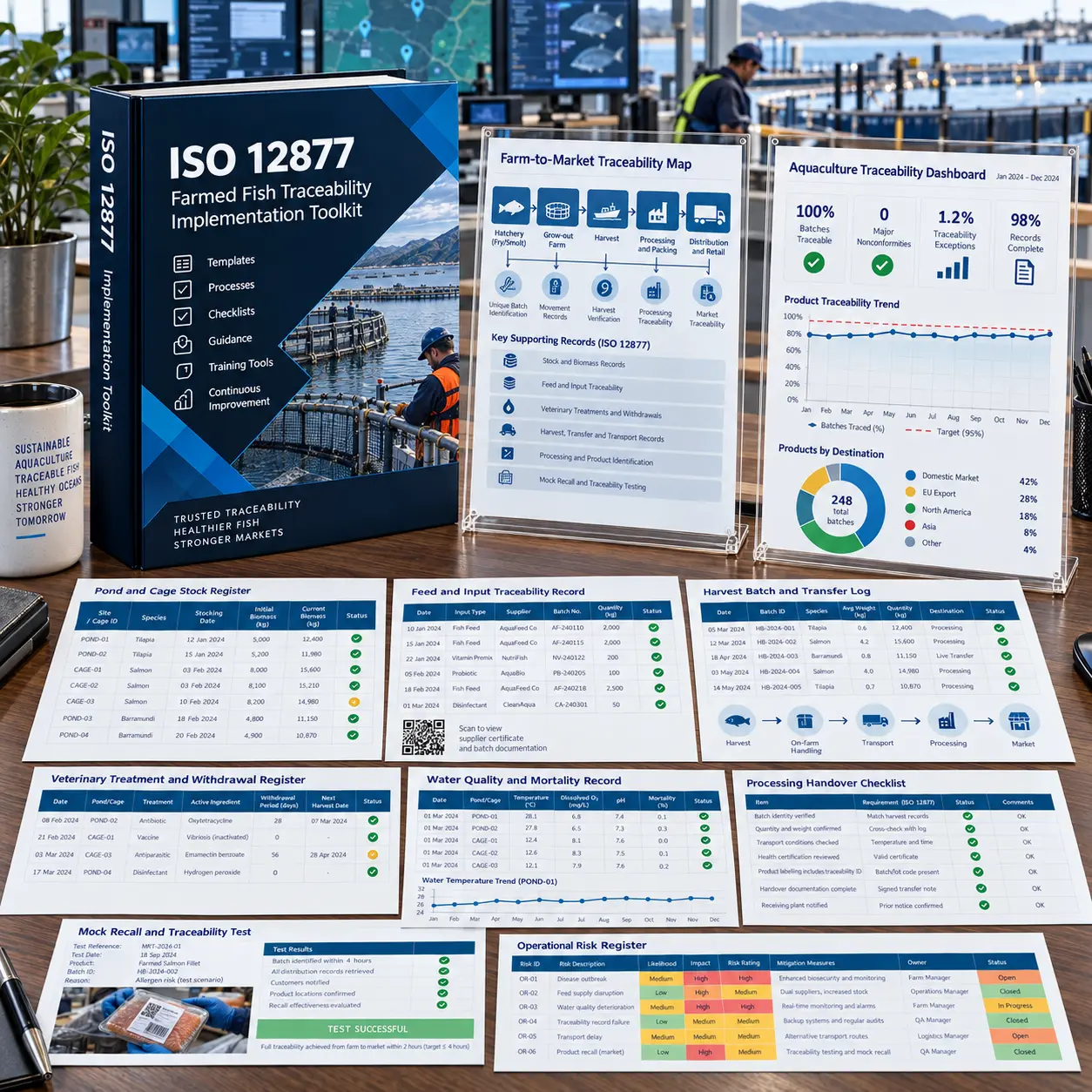
ISO 12877:2011 Farmed Fish Traceability Implementation Toolkit
The ISO 12877:2011 Farmed Fish Traceability Implementation Toolkit provides a comprehensive, easy to use set of premium templates and professionally structured implementation resources to help organizations establish reliable traceability for farmed finfish from feed, broodstock and hatchery operations through grow out farming, harvest, processing, storage, transport, wholesale, retail, and catering.
Aligned with ISO 12877:2011, the toolkit translates farmed finfish traceability information requirements into practical procedures, registers, matrices, checklists, workbooks, and presentation materials. It supports feed lot linkage, breeder and hatchery origin, farm stocking records, production cycle continuity, veterinary treatment records, harvest lot creation, processing transformation, mass balance, logistics handover, digital data integrity, traceability testing, and enterprise level audit and improvement activities.
ISO 12877 Toolkit Value & Pricing
Implementing traceability across a farmed finfish supply chain can be demanding, particularly where feed, broodstock, hatchery, nursery, farm stocking, treatments, harvest, processing, storage, transport, trading, and downstream sales data must remain linked across multiple organizations and information systems.
The ISO 12877:2011 Farmed Fish Traceability Implementation Toolkit provides a comprehensive collection of easy to use templates and structured implementation documents in Word, Excel, and PowerPoint formats. It helps organizations establish traceability data governance, map aquaculture information flows, control farm and stock origin records, link feed and treatment information to harvest lots, maintain chain of custody evidence, verify transformations and mass balance, test traceability performance, and manage exceptions more efficiently.

ISO 12877 Toolkit Document Index
Below is the structured list of documents included in the package. Expand each part to review the files before downloading the index file.
 Part 1. Enterprise Traceability Governance and Programme Initiation
 Enterprise Farmed Finfish Traceability Policy.docx ISO 12877 Implementation Charter.docx Enterprise Traceability Governance and Roles Procedure.docx
 Enterprise Traceability Operator and Site Scope Register.xlsx Traceability Programme RACI Matrix.xlsx ISO 12877 Implementation Roadmap and Action Tracker.xlsx
 Enterprise Farmed Finfish Traceability Kickoff.pptx
Part 2. Supply Chain Mapping and ISO 12877 Information Requirements
Farmed Finfish Traceability Scope and Boundaries.docx End to End Finfish Traceability Information Flow Procedure.docx ISO 12877 Information Requirement Conformance Matrix.xlsx Food Business Operator Data Responsibility Matrix.xlsx Supply Chain Actor and Traceability Exchange Map.xlsx Traceability Readiness Gap and Remediation Register.xlsx Traceability Supply Chain Architecture Workshop.pptxPart 3. Traceability Data Standards and Unit Identification
Traceable Trade Unit and Logistic Unit Identification Standard.docx Traceability Master Data and Record Control Procedure.docx Finfish Species and Product Master Data Register.xlsx Facility Farm Cage Pond and Tank Identifier Register.xlsx Trade Unit Logistic Unit and Lot Number Register.xlsx Traceability Data Dictionary and Validation Matrix.xlsx Traceability Identification and Data Model Review.pptxPart 4. Fish Feed Production and Feed Lot Traceability
Fish Feed Raw Material and Production Traceability Procedure.docx Fish Feed Lot Labelling and Dispatch Procedure.docx Fishmeal Ingredient and Feed Supplier Lot Register.xlsx Feed Manufacturing Input Output Batch Matrix.xlsx Feed Product Lot and Trade Unit Register.xlsx Feed Lot Dispatch and Recipient Linkage Log.xlsx Feed Origin and Production Lot Traceability Review.pptxPart 5. Breeder and Broodstock Origin Traceability
Broodstock Origin and Breeder Identification Procedure.docx Breeder to Hatchery Traceability Handover Procedure.docx Approved Breeder and Broodstock Source Register.xlsx Broodstock Identity Species and Origin Record.xlsx Broodstock Transfer and Spawning Batch Linkage.xlsx Breeder Unit Dispatch and Hatchery Receipt Register.xlsx Broodstock Origin Traceability Review.pptxPart 6. Hatchery Egg, Larvae and Fry Traceability
Hatchery Batch Identification and Traceability Procedure.docx Egg Larvae and Fry Transfer Recording Procedure.docx Hatchery Received Broodstock and Egg Unit Register.xlsx Spawning Egg and Hatching Batch Register.xlsx Larvae Fry Batch Split Merge and Quantity Log.xlsx Hatchery Fry Dispatch and Consignee Register.xlsx Hatchery Batch Traceability Workshop.pptxPart 7. Nursery, Juvenile Fish and Live Stock Transfers
Nursery Lot Identification and Transfer Procedure.docx Live Finfish Transport and Custody Handover Procedure.docx Juvenile Fish Receipt and Nursery Lot Register.xlsx Nursery Batch Split Transfer and Stock Count Log.xlsx Live Fish Transport Unit and Custody Register.xlsx Nursery to Farm Stock Origin Linkage Matrix.xlsx Nursery and Live Fish Transfer Review.pptxPart 8. Aquaculture Farm Sites, Units and Stocking Records
Aquaculture Farm Stocking and Unit Identification Procedure.docx Farm Stock Origin Registration and Traceability Procedure.docx Farm Site Cage Pond and Tank Master Register.xlsx Farm Stocking Event and Juvenile Lot Linkage.xlsx Aquaculture Production Cycle and Stocking Batch Register.xlsx Farm Site and Stocking Data Completeness Checklist.xlsx Aquaculture Farm Stocking Traceability Review.pptxPart 9. Grow Out Stock Movement and Production Cycle Linkages
Farm Grow Out Batch Continuity and Movement Procedure.docx Grow Out Batch and Production Cycle Register.xlsx Fish Transfer Grading and Batch Reallocation Log.xlsx Stock Mortality Removal and Quantity Reconciliation.xlsx Grow Out Lot Split Merge and Origin Linkage Register.xlsxPart 10. Feed Use, Veterinary Treatments and Farm Input Records
Farm Feed Input and Treatment Traceability Procedure.docx Veterinary Treatment Withdrawal and Harvest Linkage Procedure.docx Farm Feed Lot to Stocking Batch Usage Log.xlsx Veterinary Medicine and Treatment Batch Register.xlsx Treatment Withdrawal Period and Harvest Eligibility Matrix.xlsx Farm Input Record Completeness and Exception Log.xlsx Farm Input to Harvest Traceability Review.pptxPart 11. Harvest Events, Harvest Lots and Farm Dispatch
Aquaculture Harvest Lot Creation and Traceability Procedure.docx Harvest Dispatch and Custody Transfer Procedure.docx Harvest Event Farm Unit and Stock Batch Register.xlsx Harvest Lot Quantity Grade and Time Record.xlsx Harvest Lot Trade Unit and Logistic Unit Register.xlsx Farm to Processor Harvest Dispatch and Receipt Log.xlsx Harvest Lot and Farm Handover Review.pptxPart 12. Processor Receipt and Raw Fish Lot Registration
Farmed Finfish Receiving and Origin Verification Procedure.docx Incoming Finfish Lot Hold and Data Exception Procedure.docx Processor Incoming Fish Lot and Supplier Register.xlsx Harvest to Processing Lot Traceability Matrix.xlsx Incoming Live or Chilled Fish Receipt Checklist.xlsx Unverified Origin and Missing Data Hold Register.xlsxPart 13. Processing Transformation, Rework and Mass Balance
Finfish Processing Transformation Traceability Procedure.docx Processing Lot Split Merge and Rework Control Procedure.docx Processing Batch Input Output Lot Mapping.xlsx Processing Lot Split Merge and Rework Register.xlsx Finfish Processing Yield and Mass Balance Register.xlsx Processing Traceability Reconciliation Checklist.xlsx Processing Lot Transformation Workshop.pptxPart 14. Finished Product, Packaging and Logistic Unit Identification
Finished Finfish Unit Labelling and Traceability Procedure.docx Finished Product Lot and Trade Unit Register.xlsx Product Species Farm Origin and Lot Label Verification.xlsx Carton Pallet and Logistic Unit Aggregation Matrix.xlsx Finished Product Release and Dispatch Lot Register.xlsxPart 15. Storage, Transport and Distribution Custody Tracking
Cold Storage Lot Movement and Custody Procedure.docx Shipment Traceability and Carrier Handover Procedure.docx Warehouse Lot Location and Inventory Movement Register.xlsx Cold Storage Unit Repacking and Reconfiguration Log.xlsx Shipment Logistic Unit Carrier and Consignee Manifest.xlsx Transport Handover Delivery and Discrepancy Register.xlsx Storage and Distribution Traceability Review.pptxPart 16. Trading, Wholesale, Retail and Catering Traceability
Wholesale Trade and Customer Traceability Procedure.docx Retail and Catering Farmed Finfish Traceability Procedure.docx Trading Wholesale Receipt Sales and Allocation Register.xlsx Supplier to Customer Lot and Trade Unit Linkage.xlsx Retail Catering Inbound Unit Traceability Register.xlsx Downstream Trade Unit Data Completeness Checklist.xlsxPart 17. Digital Traceability Systems, Integration and Data Quality
Electronic Traceability Data Validation and Access Procedure.docx Traceability Record Retention and Retrieval Procedure.docx Hatchery Farm ERP WMS and Logistics Interface Mapping.xlsx Traceability Data Field Completeness and Quality Dashboard.xlsx Traceability System User Access and Audit Trail Register.xlsx Data Interface Test and Correction Log.xlsx Enterprise Digital Traceability Readiness Review.pptxPart 18. Traceability Verification, Incident Response and Withdrawal Support
End to End Farmed Finfish Traceability Test Procedure.docx Traceability Discrepancy Hold and Corrective Action Procedure.docx Product Withdrawal and Recall Traceability Support Plan.docx Feed to Farm to Customer Traceability Exercise.xlsx Forward Backward Traceability and Mass Balance Check.xlsx Traceability Exception and Corrective Action Register.xlsx Product Withdrawal Impacted Lot and Customer Register.xlsx End to End Farmed Finfish Traceability Exercise Review.pptxPart 19. Internal Audit, Competence and Enterprise Handover
ISO 12877 Internal Audit and Management Review Procedure.docx Traceability Role Competence and Training Plan.docx Enterprise Traceability Closeout and Sustainment Plan.docx ISO 12877 Operator Specific Internal Audit Checklist.xlsx Traceability Training and Competence Matrix.xlsx Enterprise Traceability KPI and Review Dashboard.xlsx Implementation Closeout and Continuous Improvement Register.xlsx Enterprise Traceability Management Review and Closeout.pptxReview the complete file index, preview free sample templates, or check the purchase and payment guide.
ISO 12877 Toolkit Package & Download Information
| Date File Updated | 01/04/2011 |
| File Format | doc, docx, xls, xlsx, ppt, pptx |
| No. of files | 129 File; 19 Folders |
| File download size | 31.71 MB (rar). |
| Language |
 English |
| Purchase code | ISO12877-Toolkits |
Ready to Implement ISO 12877:2011?
Start with the complete ISO 12877 farmed fish traceability toolkit or review the free sample before purchasing.
The hatchery and nursery templates helped us standardize batch IDs before fish were transferred to grow out sites. The handover records are straightforward and easy for operations staff to maintain.
We used the farm stocking, movement, and mortality reconciliation sheets across several sites. They gave us a much more consistent way to maintain continuity between juvenile lots and harvest batches.
The feed and treatment section is very useful. Linking feed lots, veterinary treatments, withdrawal periods, and harvest eligibility in one traceability structure solved several gaps in our previous records.
The forward and backward traceability exercise provides a good structure for checking evidence, timing the test, reconciling quantities, and following up on traceability exceptions.
Our operation has multiple cages and production cycles. The site, unit, stocking, and grow out registers made it easier to keep origin and movement information consistent.
The processor receiving and origin verification tools are practical for imported farmed fish. We now have a clearer process for holding lots when farm origin information is incomplete.
The package helped us connect harvest dispatch, cold storage, transport, and customer records back to farm and production cycle information. The manifests and handover logs are easy to use.
The templates are detailed but flexible. We customized the harvest, processing, packaging, and customer dispatch records to fit our ERP and warehouse workflow.
The traceability KPI dashboard and internal audit checklist gave management a clearer view of recurring data quality issues across hatchery, farm, processing, and distribution records.
The digital traceability section was very helpful. The interface mapping and user access registers supported our review of farm software, ERP, warehouse, and logistics traceability controls.
A strong toolkit for building a complete farmed finfish traceability file. The structure follows the chain logically from feed and broodstock through farm, harvest, processing, and customer delivery.
We used the closeout, competence, and management review templates at the end of our implementation project. They gave us a professional way to capture training needs, remaining gaps, and improvement actions.